Arenal Hot Springs: Which La Fortuna Hotels Actually Have Thermal Water (2026)
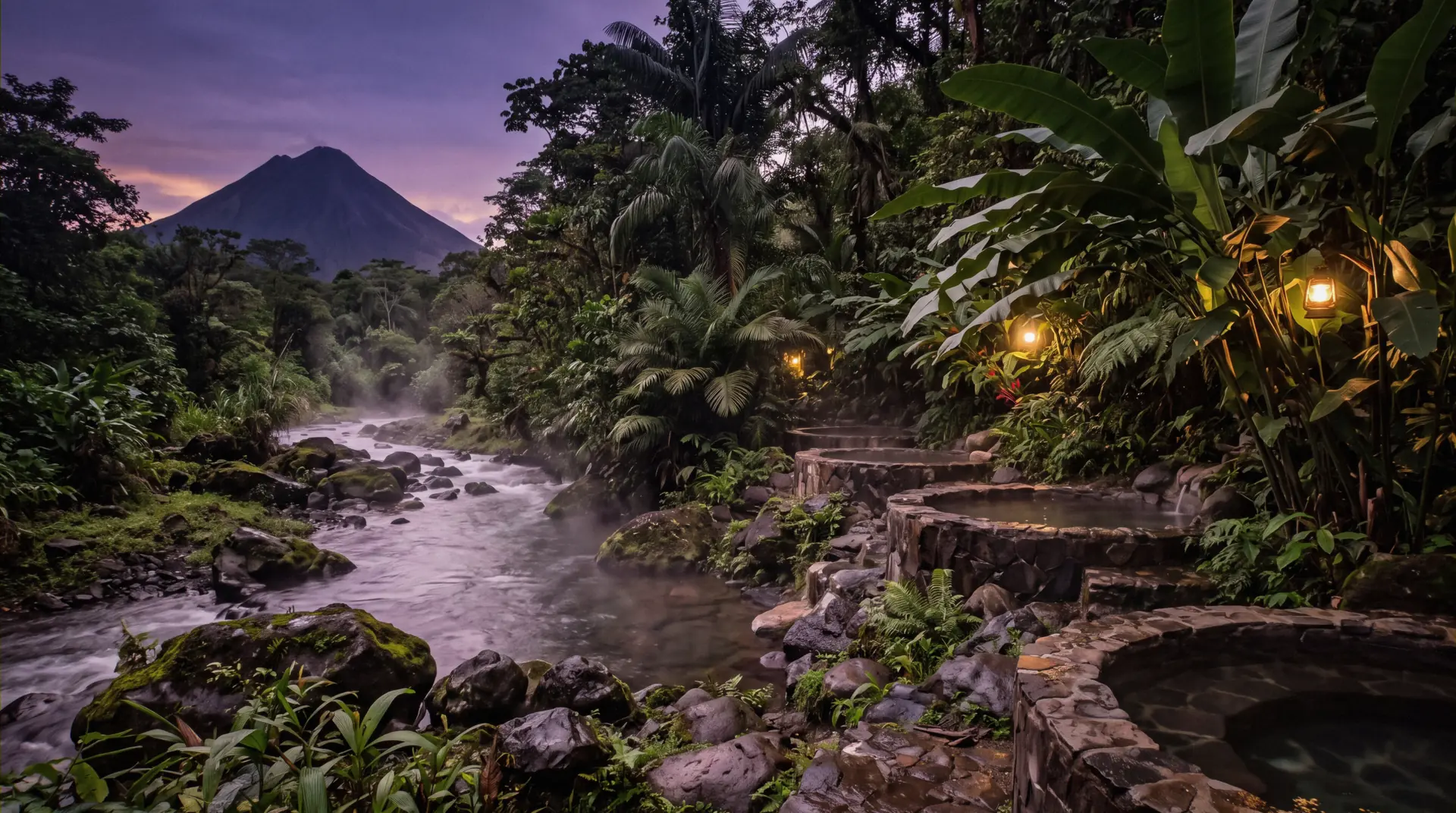
Magma under a resting volcano heats an aquifer half a mile wide, and that water surfaces on Arenal's flank. At one address it arrives as a river you can sit in; everywhere else on this page it arrives through a pipe. The La Fortuna hot springs are a ladder, not a category.
One property in La Fortuna has water that reaches it above ground. Costa Rica Travel Blog's wording on Tabacón is exact: the water 'reaches the property from above the ground (via a mountain-fed river) as opposed to below the ground (via a pump that taps into an underground spring)'.
The river is real and measured: five springs from 77°F / 25°C to 122°F / 50°C, the main flow out of two surface openings at about 20 gallons a second at 122°F / 50°C, spread through the gardens at 72–104°F / 22–40°C.
Everything else is genuine volcanic water in built pools — 25 of them at Baldi, 19 at The Springs, eight at Ecotermales, Titokú and Paradise — plus a waterpark, plus two or three properties whose thermal claim nobody has documented (the ladder).
Tabacón's day pass is quoted at US$89, US$99, US$110, US$115, 'from $140' and 'around $165' across six sources, with the child rate at US$47 or US$55. Nobody should print one number, and this page does not (what a pass costs).
The same Río Tabacón runs free under the road bridge across from the resort entrance, 12–13 km from town, around the clock. No lifeguards, no staff, no lockers, sharp and slippery rocks, and reported car break-ins (the free river).
Do not expect lava. Arenal entered a resting phase in October 2010, ending 42 years of eruption; it is still classified active, with summit steam (the volcano).
Quiet costs less than luxury here: Paradise Hot Springs caps daily numbers around eight pools, and Ecotermales takes about 100 people a day across two booked sessions at US$49 a head.
Springs facts, day-pass prices and park hours checked August 2026. Hotel ratings and nightly rates are a snapshot for 10–13 November 2026, two adults.
Arenal Hot Springs Hotels, Compared
Nine properties on the same volcanic aquifer, sorted by the only question that separates them: how the thermal water actually gets to the pool, and whether anyone independent has confirmed it does.
Río Tabacón, above ground. Arenal.net reports five springs from 77°F / 25°C to 122°F / 50°C, with the main flow emerging from two surface openings at about 20 gallons a second at 122°F / 50°C; the gardens spread it at 72–104°F / 22–40°C
Five thermal pools plus the free-flowing river with built waterfalls and soaking pockets, per Costa Rica Travel Blog; Soak Destinations advertises '20+ thermal pools and waterfalls' — the counts are not reconciled anywhere
Complimentary thermal access for the length of the stay, plus the adults-only Shangri-La Gardens that no day-pass buyer can enter; Mytanfeet reports two extra hours reserved for hotel guests
Mineral thermal water piped to the villas. The operator says each plunge pool is 'fed by natural mineral thermal waters flowing down from the Arenal Volcano' and names calcium, magnesium, bicarbonate and silica — its own blog, not an independent assay
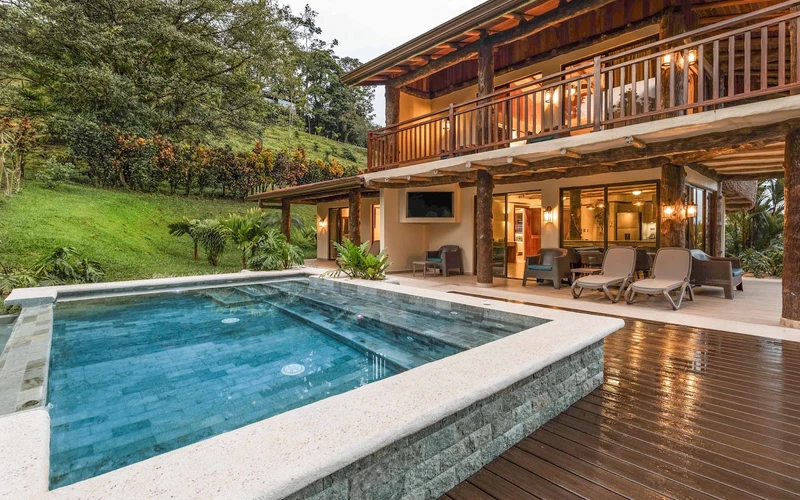
One private plunge pool per villa across 35 villas, plus two outdoor resort pools; there is no shared thermal bathing complex here
The water comes to the villa; access is the room. No day passes are sold
Thermal-fed but engineered. Mytanfeet describes both natural and chlorinated options on the property; El Tucano's comparison says outright that 'the pools are designed rather than natural'
19 pools per Mytanfeet — 12 in the Las Lagunas cluster and 7 in Los Perdidos — running 83–104°F / 28–40°C, plus waterfalls and cold springs
Springs, wildlife preserve and trails carry no additional fee for hotel guests; Club Río activities are US$20–40 per person extra and are not in the room rate
Operator claim only. Arenal Manoa says its pools and ponds are 'fed by mineral-rich thermal waters'; no independent source read corroborates the water source, and no temperature is published
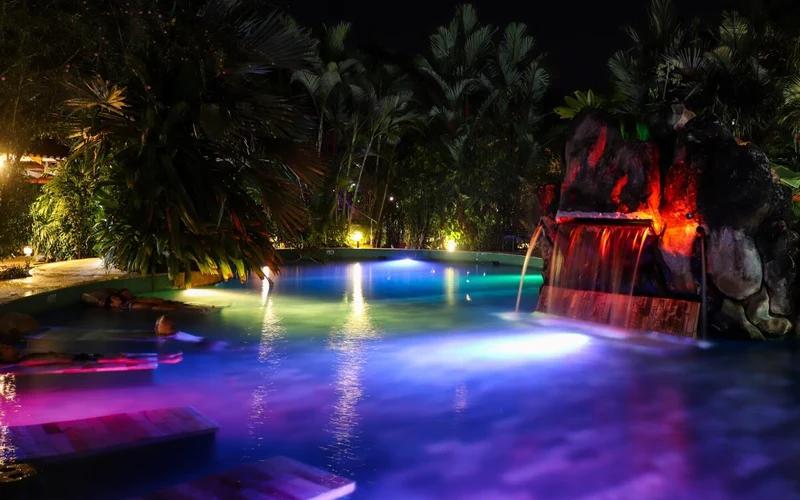
Several hot spring pools and ponds across the property, plus a swim-up bar, a sushi bar, a kids' pool and hot tubs
The whole springs complex is reserved for hotel guests — no day passes are sold to the public
Volcanic aquifer, engineered into pools. Mytanfeet publishes a 91–152°F / 33–67°C range across the property — the top of that is not a bathing temperature and is best read as a source or inaccessible feature
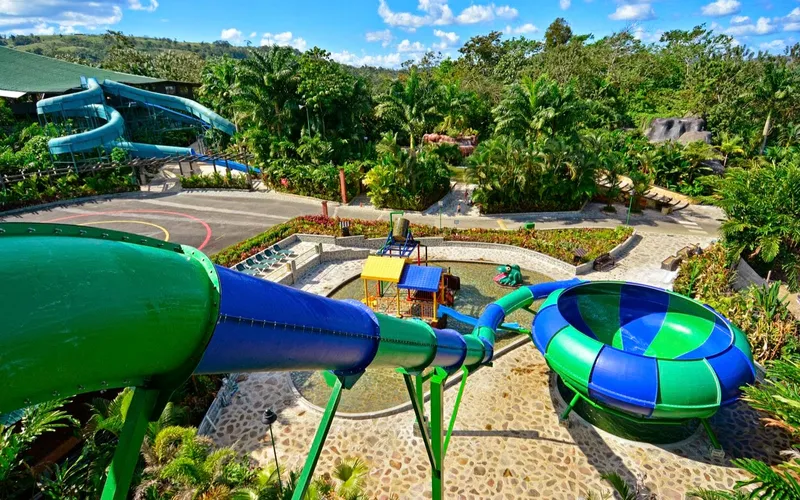
25 thermal pools fed by built waterfalls, plus waterslides and an interactive kids' splash zone
Rooms sit inside the complex, so the pools come with the stay; day passes reported at US$51 adult without a meal, US$75 with one, US$99 with lunch and dinner
Not established. Mytanfeet's write-up does not describe the water as naturally thermal — unlike its entries for Tabacón, Baldi, Ecotermales, Titokú and Paradise — and gives the hottest pool as 100°F / 38°C, a figure whose own conversion is off in the source
Multiple pools at different temperatures, open-air baths, a long water slide and a lazy river, with a butterfly garden and a turtle and crocodile pond alongside
Pools come with the room; day passes reported at US$52 per adult and US$43 per child, meal included
None. An ordinary outdoor pool and no thermal claim anywhere — this is the budget route, where every soak is a day pass plus a drive
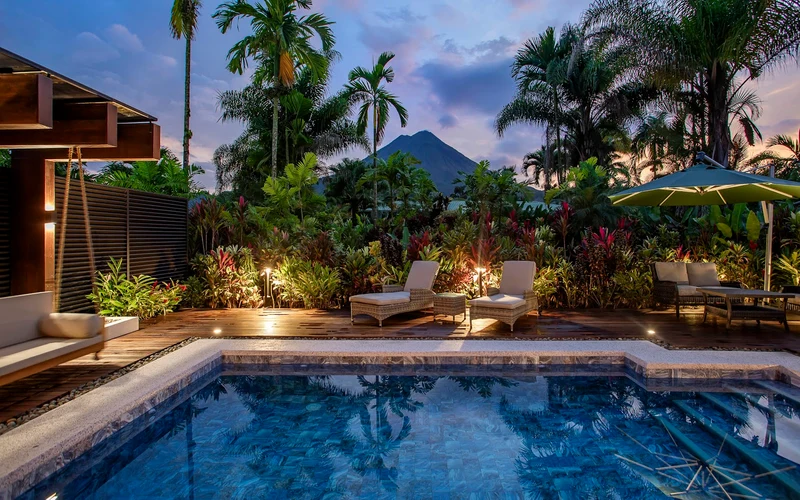
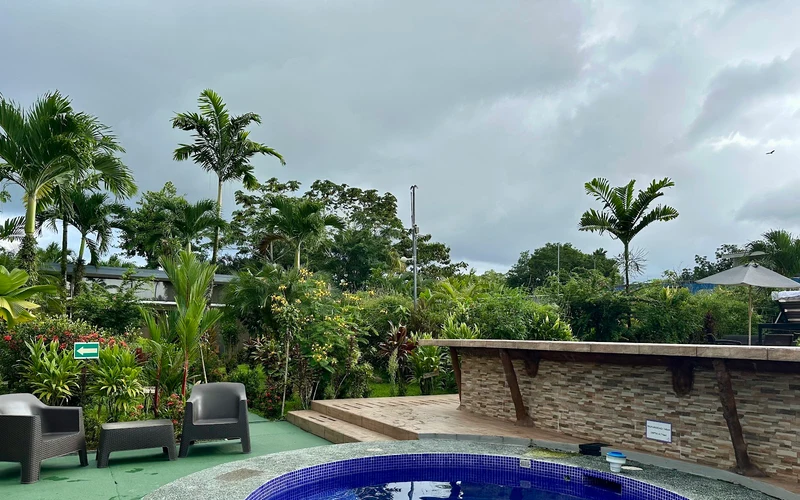
One outdoor pool with tiled surrounds, gardens with volcano views
Nothing thermal included; the springs corridor on Route 142 starts about 4 km out and runs to Tabacón at 13 km
4.6/5 (685)
$112
Nightly rates are a snapshot for a 10–13 November 2026 stay, two adults, and move sharply with season — the peak window reported for Tabacón runs 18 December to 8 January. Day-pass figures are third-party and dated August 2026; several operators publish no prices on their own sites at all.
Which One Is for You
Four questions settle La Fortuna: do you want water that arrives above ground, do you want the pools empty, do you have children who want slides, and are you willing to pay resort rates for either.
Each property below is judged on what its own operator publishes and what independent sources confirm: where the water comes from, what a room includes, and what a day-tripper can and cannot get into.
Source temperature
122°F / 50°C
Tabacón's main flow surfaces at 122°F / 50°C and spreads through the gardens at 72–104°F / 22–40°C. Baldi's sources reach 152°F / 67°C, which is not a bathing temperature.
When to soak
Year-round
September and October are the wettest months — cloud hides the cone, the water stays warm regardless.
Day entry
$89–165 day pass
Tabacón's own price appears six different ways across six sources; none is reconciled here. Checked August 2026.
Elevation
820 ft
Altitude shortens comfortable soaking time — drink water.
Kids
mixed
Under 6 free at Tabacón, under 16 must be accompanied; Shangri-La Gardens is adults-only and hotel-guests-only.
Nearest airport
San José (SJO)
About 195 minutes by road.
The Hotels, One by One
Ordered by how the thermal water reaches the property — above ground first, then piped, then claimed but undocumented, then none at all.
The thermal river runs through it
Tabacón Thermal Resort and Spa
4.6/5
Route 142, about 13 km northwest of La Fortuna town, on the flank of Arenal · 3,475 Google reviews
Hot springs on-site
Water
Río Tabacón, above ground. Arenal.net reports five springs from 77°F / 25°C to 122°F / 50°C, with the main flow emerging from two surface openings at about 20 gallons a second at 122°F / 50°C; the gardens spread it at 72–104°F / 22–40°C
Pools
Five thermal pools plus the free-flowing river with built waterfalls and soaking pockets, per Costa Rica Travel Blog; Soak Destinations advertises '20+ thermal pools and waterfalls' — the counts are not reconciled anywhere
Room includes
Complimentary thermal access for the length of the stay, plus the adults-only Shangri-La Gardens that no day-pass buyer can enter; Mytanfeet reports two extra hours reserved for hotel guests
Kids
All ages; under 6 free, under 16 must be accompanied
Costa Rica Travel Blog puts the distinction plainly: some of Tabacón's thermal water 'reaches the property from above the ground (via a mountain-fed river) as opposed to below the ground (via a pump that taps into an underground spring)'. That single sentence is why this property is first on the page and why it costs what it costs.
The day-pass price is a mess and this page prints it as one: US$89, US$99, US$110, US$115, 'from $140' and 'around $165' across six sources, with the child rate at US$47 in one and US$55 in another (what a day pass costs).
Shangri-La Gardens is adults-only AND hotel-guest-only. Buying a day pass does not get you in, which is the kind of thing people discover at the gate.
The day-pass window itself runs 10:00 to 22:00 daily. No separate evening-pass product was found on any source read, so do not go looking for a cheap night rate.
Off Route 702 on the Nayara estate, roughly 12 km from town toward the volcano · 636 Google reviews
Hot springs on-site
Water
Mineral thermal water piped to the villas. The operator says each plunge pool is 'fed by natural mineral thermal waters flowing down from the Arenal Volcano' and names calcium, magnesium, bicarbonate and silica — its own blog, not an independent assay
Pools
One private plunge pool per villa across 35 villas, plus two outdoor resort pools; there is no shared thermal bathing complex here
Room includes
The water comes to the villa; access is the room. No day passes are sold
Kids
Adults-only (Nayara Gardens is the family sister property)
This is the opposite trade from Tabacón: no soaking landscape at all, and no one else in your water. Thirty-five free-standing villas, each with an oversized plunge pool, butler service and breakfast served in the room.
Nayara publishes no water temperature anywhere — the villa pools are described only as 'naturally warm'. If a number matters to you, this page cannot give you one.
Reviews here are close to unanimous on service, cleanliness and the pools, on a sample in the hundreds — unusual at any price.
Adults-only means adults-only. Families on the same estate stay at Nayara Gardens, where the private spring-fed plunge pools are not standard; confirm what a Gardens room includes before booking it as a springs stay.
Hillside above the Río Arenal, about 9 km west and 4 km north of La Fortuna centre · 2,247 Google reviews
Hot springs on-site
Water
Thermal-fed but engineered. Mytanfeet describes both natural and chlorinated options on the property; El Tucano's comparison says outright that 'the pools are designed rather than natural'
Pools
19 pools per Mytanfeet — 12 in the Las Lagunas cluster and 7 in Los Perdidos — running 83–104°F / 28–40°C, plus waterfalls and cold springs
Room includes
Springs, wildlife preserve and trails carry no additional fee for hotel guests; Club Río activities are US$20–40 per person extra and are not in the room rate
Kids
All ages; no adults-only zone found in any source read
The biggest soaking landscape you can get for free with a room, and the honest caveat belongs in the same sentence: these are built pools fed by the volcanic aquifer, not a river you can walk into.
The two pool clusters sit at different levels of the hillside, which is why the day pass is valid for two consecutive days — arrive any time after 08:00 and stay until 22:00 on each, with free in and out.
Club Río is a separate riverside adventure centre — kayaking, tubing, horseback riding, a climbing wall — and every activity there is charged on top. Guests regularly assume it is included.
Nature and property are the strongest review topics here by a wide margin, which matches what the resort actually is: a hillside with a view of the cone and a lot of warm water on it.
La Palma, about 8 km from La Fortuna bus station, facing the volcano · 2,414 Google reviews
Hot springs on-site
Water
Operator claim only. Arenal Manoa says its pools and ponds are 'fed by mineral-rich thermal waters'; no independent source read corroborates the water source, and no temperature is published
Pools
Several hot spring pools and ponds across the property, plus a swim-up bar, a sushi bar, a kids' pool and hot tubs
Room includes
The whole springs complex is reserved for hotel guests — no day passes are sold to the public
Kids
All ages; kids' pool on site
The reason to book it is the rule: 'The natural hot spring pools are reserved exclusively for guests of the hotel, providing a rare, uncrowded experience.' In a town where the big complexes sell thousands of day passes, that is the product.
Treat the thermal claim as the operator's own. Nothing in the sources read confirms the water source, and no temperature figure exists — which is not the same as saying the water is not thermal, only that nobody independent has said it is.
Duplex suites with terraces angled at the cone, free breakfast and free farm tours; service and atmosphere carry the reviews on a sample of thousands.
Cheaper than Tabacón, The Springs and Kioro, and the only property in that price band whose water no day-tripper can share.
Route 142, about 5 km northwest of the La Fortuna town park · 1,858 Google reviews
Hot springs on-site
Water
Natural mineral thermal water, reported at 95–104°F / 35–40°C by Mytanfeet — a soaking range rather than a source figure
Pools
Eight thermal pools in the gardens, one with a swim-up bar, plus hot tubs
Room includes
Pools come with the room; day passes are also sold at roughly US$47 entrance only, about US$74 with a meal (Mytanfeet, as published)
Kids
All ages; no adults-only designation found
Twenty-five rooms wrapped around eight pools, with a stated cap on daily users — the nearest thing to Ecotermales' calm with a bed attached, and roughly a third of Tabacón's nightly rate.
Its 95–104°F / 35–40°C range is the most usable one on this page: no scalding source figure, no 30-degree spread, just water you can sit in.
Nature and atmosphere score close to perfect in guest reviews; the pool topic is the weakest of its strong ones, which reads as crowding on day-pass afternoons.
If the trip is a soak rather than a resort holiday, this is the value pick — and the day pass is cheap enough that people staying in town use it as their one paid springs day.
About 11 km northwest of La Fortuna centre, on 11 hectares between two streams · 1,098 Google reviews
Hot springs on-site
Water
Volcanic thermal water at the Titokú complex; no temperature range is published in any source read, for either the hotel pools or Titokú
Pools
Hot spring pools at the hotel itself, plus the eight-pool Titokú complex — 'water from the gods' in the operator's gloss — a short shuttle ride away
Room includes
Onsite pools plus free Titokú entry with a complimentary shuttle; every suite also has its own whirlpool tub
Kids
All ages; no published child policy found for Titokú
Onsite with an asterisk. The eight-pool Titokú complex is not on the hotel grounds — you ride a shuttle to it — but guests pay nothing to get in, and Titokú is the cheapest named thermal complex in town at roughly US$33 per adult on the gate.
No source read publishes a water temperature for either Titokú or the hotel's own pools. If you want numbers before you book, this is not the property that has them.
Fifty-three suites with private terraces, volcano views and in-room whirlpool tubs; two restaurants and two bars, breakfast buffet included.
Nature and pool are the highest-scoring review topics here, and the property sits close enough to Tabacón that a day pass there is a short drive rather than an expedition.
Route 142 at the base of the volcano, about 4 km from La Fortuna centre · 8,931 Google reviews
Hot springs on-site
Water
Volcanic aquifer, engineered into pools. Mytanfeet publishes a 91–152°F / 33–67°C range across the property — the top of that is not a bathing temperature and is best read as a source or inaccessible feature
Pools
25 thermal pools fed by built waterfalls, plus waterslides and an interactive kids' splash zone
Room includes
Rooms sit inside the complex, so the pools come with the stay; day passes reported at US$51 adult without a meal, US$75 with one, US$99 with lunch and dinner
Kids
All ages; 0–5 free, 6–10 child rate, 11 and over pays adult
The most water and the most slides in La Fortuna, and also the most noise — swim-up bars, music in parts of the property, and a reputation that is family and party rather than quiet soak.
Do not read 152°F / 67°C as a pool you can sit in. Mytanfeet publishes 91–152°F / 33–67°C as the range across the property; the top end is presented as the hottest/source end, not a bathing temperature, and no source read identifies which pool it belongs to.
Baldi's own site markets it as 'the World's Largest hot springs' and gives no pricing at all — every day-pass figure on this page for Baldi comes from third parties.
Nearly nine thousand reviews, and the pool and atmosphere topics carry them. If you are travelling with children who want slides, this is the answer; if you want a quiet soak, book elsewhere and buy a day pass only if the slides are the point.
About 6 km west of the La Fortuna central park, 4 km from the volcano · 4,303 Google reviews
Hot springs on-site
Water
Not established. Mytanfeet's write-up does not describe the water as naturally thermal — unlike its entries for Tabacón, Baldi, Ecotermales, Titokú and Paradise — and gives the hottest pool as 100°F / 38°C, a figure whose own conversion is off in the source
Pools
Multiple pools at different temperatures, open-air baths, a long water slide and a lazy river, with a butterfly garden and a turtle and crocodile pond alongside
Room includes
Pools come with the room; day passes reported at US$52 per adult and US$43 per child, meal included
Kids
All ages; lifeguard on the pool deck, wading pool, slide
Listed here as the honest step down the ladder. The water is warm and the resort's own marketing calls the baths hot spring baths, but no source read documents a thermal source for it — so this page calls them warm pools with a view rather than volcanic springs.
As a family resort it is a strong one: over four thousand reviews, with pool, family and breakfast as the top-scoring topics, and the butterfly garden and turtle pond included in the day rate.
The published 100°F / 38°C hottest-pool figure comes with a caution — the source's own Celsius-to-Fahrenheit conversion does not match, so treat it as approximate.
The day pass with a meal at US$52 is one of the cheapest full days in La Fortuna, which is the real reason people end up here.
Calle 466A, in La Fortuna town, walking distance to restaurants and the bus stop · 685 Google reviews
Drive to the springs
Water
None. An ordinary outdoor pool and no thermal claim anywhere — this is the budget route, where every soak is a day pass plus a drive
Pools
One outdoor pool with tiled surrounds, gardens with volcano views
Room includes
Nothing thermal included; the springs corridor on Route 142 starts about 4 km out and runs to Tabacón at 13 km
Kids
All ages
The comparison that makes the rest of the page legible: a well-run town hotel at a fraction of a springs resort's rate, with the whole cost of soaking still ahead of you.
The arithmetic decides it. Two people at Ecotermales for US$49 each, or at Paradise for about US$47, is roughly US$100 a day on top of the room — three nights of that closes most of the gap to a mid-range springs resort.
What it does have is town: restaurants at the door, the bus stop, tour desks, and no 20-minute drive back up Route 142 in the dark after dinner.
Location, service and breakfast are its strongest review topics across nearly seven hundred reviews, and the pool topic is unanimously positive — for an ordinary pool.
Rates shown are snapshots for 10–13 November 2026, two adults, and change daily. Some links on this page are affiliate links; they cost you nothing and don't change our ordering.
Prefer to browse everything bookable in La Fortuna? Search all stays:
Where the Water Actually Is
La Fortuna's springs sit along one road. Route 142 leaves town heading northwest and climbs the volcano's flank; the complexes are strung along it in rough order of price, from about 4 km out to the Tabacón corridor at 12–13 km.
The Tabacón corridor, 12–13 km out
the thermal river, above ground
Río Tabacón itself, landscaped into waterfalls and soaking pockets at 72–104°F / 22–40°CFive built thermal pools alongside the riverShangri-La Gardens — adults-only and hotel-guest-onlyThe free public river under the road bridge, downstream, no facilities
The resort entrance and the free river are opposite each other across Route 142 — the same water, one side ticketed and landscaped, the other side loose rock and no supervision.
The hillside resorts, 8–12 km out
engineered pools, volcanic aquifer
19 terraced pools at The Springs, 83–104°F / 28–40°C, in two clustersPrivate spring-fed plunge pools in 35 villas at Nayara SpringsGuest-only pools and ponds at Arenal Manoa
This is the tier where the water is genuinely of volcanic origin and the experience is designed. El Tucano's comparison says it of The Springs outright: 'The pools are designed rather than natural.'
The Route 142 complexes, 4–7 km out
day passes, slides, crowds
25 pools plus waterslides at BaldiEight pools with a swim-up bar at ParadiseEight pools at Titokú, free to Kioro guestsA three-storey slide tower at Kalambu, which is a waterpark
Ecotermales Fortuna also sits in this stretch and has no rooms at all — reservation-only, about 100 people a day across two sessions, US$49 adult and US$29 for children 5 to 11.
La Fortuna town
no thermal water, 15–20 minutes to the springs
Ordinary hotel poolsNothing thermal in the town centre
Cheaper beds, restaurants at the door, and every soak charged separately. The honest budget route, not a springs stay.
⟷Tabacón and the free river are the same water minutes apart — one is landscaped and staffed, the other is a scramble down a bank.
⟷Hotel Arenal Kioro puts you in the Tabacón corridor at a lower rate, with free shuttle access to the eight-pool Titokú complex instead of a river.
⟷Paradise Hot Springs and Baldi sit within a couple of kilometres of each other on Route 142 and are opposites: capped numbers and eight quiet pools against 25 pools and a slide tower.
⟷From Hotel Secreto La Fortuna in town, everything above is a 10 to 25 minute drive, and a rental car or a shuttle is effectively mandatory.
hot springs on-sitewalk to the springsdrive to the springsno thermal water
Arenal Springs by the Numbers
Every figure here is what an operator or a guide published, quoted rather than averaged — and where sources disagree, both numbers are printed.
Tabacón source temperature
122°F / 50°C
Arenal.net reports five springs from 77°F / 25°C to 122°F / 50°C, with the main flow emerging at 122°F / 50°C. This is source water, not a pool you sit in.
Tabacón bathing range
72–104°F / 22–40°C
Costa Rica Travel Blog's figure for the whole thermal experience; Mytanfeet gives 72–105°F / 22–41°C. Soak Destinations' body text says 72–100°F / 22–38°C for the river section while its own summary table says 72–104°F / 22–40°C.
Main flow rate
About 20 gallons per second
Arenal.net: the main springs 'emerge from two surface openings at the rate of 80 liters (~20 gallons) per second' and flow through the resort gardens.
Tabacón adult day pass
US$89 to about US$165
Six sources, six numbers: US$89 (Costa Rica Travel Blog), US$99 (Soak Destinations), US$110 (machupicchu.org), US$115 (Mytanfeet), 'from $140' and 'around $165' on reseller listings for meal-inclusive versions. Child rate US$47 or US$55 depending on source.
Cheapest named thermal complex
About US$33
Titokú Hot Springs, per Mytanfeet, entrance only; about US$52 with a meal. Free to guests of Hotel Arenal Kioro via a complimentary shuttle.
Cost of the free river
US$0
The public stretch of the Río Tabacón has no gate and no ticket. Informal parking operators reportedly ask 1,000–5,000 colones, roughly US$1.80 to US$9.
One River, Then Everything Else
Arenal stopped erupting and never stopped heating. Under the national park sits an aquifer described by one guide as roughly half a mile wide and six-tenths of a mile deep, warmed by the magmatic system beneath an active stratovolcano, and it is that aquifer — not any single spring — that every hot springs resort in La Fortuna draws on. The marketing is therefore never quite a lie. The question worth asking is not whether the water is volcanic. It is how the water gets to the pool.
At the top of the ladder there is exactly one answer. The Río Tabacón is an above-ground thermal river: five springs feed it, arenal.net reports temperatures from 77°F / 25°C to 122°F / 50°C across them, and the main flow comes out of two surface openings at about 20 gallons a second at 122°F / 50°C. It runs through the Tabacón resort's gardens, which have been landscaped into waterfalls and soaking pockets between 72°F / 22°C and 104°F / 40°C. Costa Rica Travel Blog draws the line for us: the water 'reaches the property from above the ground (via a mountain-fed river) as opposed to below the ground (via a pump that taps into an underground spring)'. That is the whole premium, stated in one sentence.
One rung down sit the properties with genuine volcanic water in engineered pools — most of what La Fortuna sells. Baldi has 25 pools filled from built waterfalls, with a published range of 91°F / 33°C to 152°F / 67°C across the property. The Springs has 19 pools in two hillside clusters at 83–104°F / 28–40°C, and El Tucano's comparison of the town's hotels says it plainly: 'The pools are designed rather than natural, but the setting and the quality of the spa programming are serious.' Ecotermales runs eight pools at 90–106°F / 32–41°C on a reservation-only cap of about 100 people a day. Titokú has eight, Paradise has eight at 95–104°F / 35–40°C, and Kalambu is a waterpark with a three-storey slide tower that happens to run thermal water through it. None of that is fake. It is simply pumped, filtered and shaped, and it costs less than the river for a reason.
The bottom rung is the one nobody labels. Los Lagos markets hot spring baths, but the careful sources that call Tabacón, Baldi, Ecotermales, Titokú and Paradise thermal stop short of saying it of Los Lagos — so this page calls those warm pools. Arenal Springs Resort and Arenal Manoa rest on operator marketing alone: plausible, uncorroborated, no temperatures published. Volcano Lodge markets a 'thermal experience' and nothing about its water source, pool count or temperature could be verified anywhere, which is why it is not carded here at all. Absence of proof is not proof of absence, but on a page about where the water comes from, an unverifiable claim does not get printed as a fact.
What a Day Pass Actually Costs
Tabacón's price is the single messiest number in this guide, and reconciling it would be inventing information. As of the August 2026 check the adult day pass is published at US$89 by Costa Rica Travel Blog, US$99 by Soak Destinations, US$110 by machupicchu.org and US$115 by Mytanfeet, while reseller listings quote 'from $140' and around US$165 for meal-inclusive versions. The child rate is US$47 in one source and US$55 in another. Meal packages run higher again — US$168 adult and US$90 child for a culinary package, US$184 with a meal on another page. Rates are almost certainly seasonal and package-dependent, with a peak window reported from 18 December to 8 January.
The rest of the town is easier to pin down, though still second-hand. Titokú is the cheapest of the named complexes at roughly US$33 entrance only, about US$52 with a meal. Paradise is around US$47. Ecotermales charges US$49 for adults and US$29 for children 5 to 11, or US$67 and US$39 with lunch or dinner on the published 2025–2026 rate, towels and lockers included. Baldi is quoted at US$51 without a meal and US$99 with lunch and dinner, though aggregator pages carry US$60 and US$85 as well. Los Lagos is US$52 per adult and US$43 per child with a meal. Kalambu is listed from US$70, discounted around US$42, and from US$32 on reseller pages. The Springs is the outlier at US$124.30 to US$141.25 per person — but that ticket is valid for two consecutive days, arriving any time after 08:00 and staying until 22:00 on each, with free in and out.
Two practical warnings before you plan around any of this. First, no separate Tabacón evening pass turned up on any source read. The day pass window itself runs 10:00 to 22:00, so an evening-only product may simply not exist as a distinct thing to buy. Second, the pass does not buy the whole property: Shangri-La Gardens is adults-only and hotel-guest-only, so day visitors are excluded from it entirely. Guests under 6 enter free, the child rate covers ages 6 to 11, and anyone under 16 must be accompanied by an adult at all times.
Two of the best properties sell nothing at the gate. Arenal Manoa's springs complex is open only to hotel guests, and Nayara Springs takes no day visitors at all — the water there is in the villa, not in a shared pool. If your plan was to stay cheap in town and buy your way into the nicest water, those two are not available at any price.
Tabacón: US$89 / $99 / $110 / $115 / from $140 / ~$165 across six sources. Child US$47 or US$55. Confirm at booking.
Titokú about US$33 · Paradise about US$47 · Ecotermales US$49 · Baldi US$51 · Los Lagos US$52 with meal.
The Springs US$124.30–141.25, valid two consecutive days, 08:00 to 22:00 each day.
No Tabacón evening-pass rate was found anywhere; the day pass itself runs 10:00–22:00.
Arenal Manoa and Nayara Springs sell no day passes — those pools require a room.
The Free River, and Why Every Guide That Recommends It Also Warns About It
The Río Tabacón does not stop at the resort fence. Downstream, where Route 142 crosses it on a road bridge directly across from the Tabacón entrance, anyone can climb down the bank and sit in the same volcanically heated water. Locals call it El Choyín, Río Chollín or Tabaconcito. It is about 12–13 km from La Fortuna town, roughly a 15 to 20 minute drive, and there is no gate, no ticket, no opening hour and nobody in charge.
That last part is the important one, and it needs stating precisely. No source read reported an official closure or restriction as of August 2026 — and no official authorisation either. No municipal, SINAC or tourism-board document was found either permitting or prohibiting bathing there. The honest description is customary and unregulated access, not legal access, and the difference matters if anything goes wrong.
What every guide that recommends the place also says, quoted rather than softened: the rocks you climb over are 'incredibly slippery' and 'quite sharp in places'; there are 'no lifeguards on duty…no staff members or police officers around'; 'the river can be rough at times'; the site 'is unsupervised and not particularly safe, and there are no change rooms, lockers, or places to store personal belongings'; and 'make sure you lock your car and don't leave any valuables inside as break-ins do happen'. Informal parking operators reportedly ask 1,000 to 5,000 colones — roughly US$1.80 to US$9 — to watch cars, which is not an official fee and not a guarantee of anything. It is also no longer a secret: one guide notes the springs 'have become so popular in recent years that they no longer feel off the beaten track'.
Two things this page will not tell you. Nobody has measured the water temperature, so none is printed here. And flash flooding was not documented in any source read — the strongest wording anyone used is that the river 'can be rough at times', and inflating that into a flood warning would be as dishonest as leaving it out. Go early or late, go with someone, wear shoes you can grip in, take nothing you would mind losing, and treat it as what it is: a roadside river with warm water and no safety net.
The Volcano: No Lava, and That Is Fine
People book Arenal expecting the postcard from the 1990s — the glowing cone, the rocks tumbling down the flank at night. That ended. Arenal entered a resting phase in October 2010, closing 42 years of continuous lava flows and explosive eruptions that ran from 1968. It is still classified as active, with steam emissions from the summit crater and the occasional small phreatic event, but visible lava is not something to expect in 2026. Anyone selling you a lava-viewing evening is selling you a silhouette.
The park is still worth the morning. Arenal Volcano National Park is open every day from 08:00 to 16:00, in two sectors — Volcano and Peninsula — with trails including Heliconias, Coladas, Tucanes and Los Miradores that cross the remains of old lava tracts and rainforest. There is no bathing anywhere inside it; every hot spring in this guide sits outside the boundary on private land. The park is the heat source, not a soaking site.
On the entry fee, a caveat that belongs in the open: SINAC's own page could not be read. Its certificate failed verification on every attempt, so the widely reported US$15 plus 13% tax for adults — about US$17 — and US$5 plus tax for children under 12, with one ticket valid for both sectors on the same calendar day, comes from a secondary 2026 guide and has not been confirmed against the managing authority. Budget for it, but check at the gate.
Getting There, and When to Come
La Fortuna is a drive from either coast-side airport, and roughly the same drive from both. From Juan Santamaría (SJO) in San José the standard figure is 3 to 3.5 hours depending on the route; from Liberia (LIR) it is about 3 hours, with shuttle operators quoting anywhere from 2.5 to 3.5. Neither is a short transfer, and neither is a road to be doing for the first time after dark.
The most useful onward connection is the Lake Arenal taxi-boat-taxi to Monteverde: a van to the lakeshore, a covered boat across, a van up the other side, about 3 to 3.5 hours door to door — some operators say 3.5 to 4 — at US$30 to US$55 with luggage handled. It runs year round, twice daily, and it turns what would be a long circuitous drive into the easiest leg of a Costa Rica itinerary.
Season is where La Fortuna reassures rather than warns. The rainy season runs roughly May to November, and September and October are the wettest months — October is reported at about 333 mm. What rain costs you is the view: cloud will very likely hide the cone for stretches of a wet-season stay, and that is the real seasonal trade. What it does not cost you is the soak. The water is volcanically heated year round, and sitting in a 100°F / 38°C pool in warm rain is, for most people, an improvement rather than a compromise. If the volcano photograph is the point of the trip, aim at the drier months. If the water is the point, come whenever it is cheap.
One currency note: Costa Rican tourism prices are published and quoted in US dollars, and every figure on this page is in USD. Colones appear exactly once — the informal parking fee at the free river.
SJO (San José) to La Fortuna: about 3 to 3.5 hours by road.
LIR (Liberia) to La Fortuna: about 3 hours.
Taxi-boat-taxi to Monteverde: 3 to 3.5 hours, US$30–55, year round, twice daily.
Wettest months: September and October, October about 333 mm — cloud hides the cone, the water stays warm.
Arenal Volcano National Park: open daily 08:00 to 16:00, no bathing inside.
How This Page Was Put Together
Springs facts come from each operator's own site where it could be read, and from Costa Rica Travel Blog, Mytanfeet, Soak Destinations, arenal.net and Two Weeks in Costa Rica where it could not — all read in August 2026. Hotel ratings, review counts and nightly rates come from a single Google Hotels snapshot for a 10–13 November 2026 stay, two adults. Where an operator publishes nothing about its water, this page records the absence instead of inferring anything from it.
The biggest sourcing problem here is the anchor property itself. Tabacón's own website is JavaScript-rendered: its /hot-springs/ and /day-pass/ pages returned no usable text to an automated reader, and /one-day-pass returned a 404. Every Tabacón price on this page is therefore third-party, which is exactly why six sources produce six numbers. Confirm the current rate with the resort at booking rather than trusting any figure here, including ours.
SINAC's official Arenal Volcano National Park page failed its TLS check and could not be read at all, so the park's entry fee is secondary and unverified. Baldi publishes no pricing on its own site. Nayara publishes no water temperature, and the mineral profile quoted for its villa pools — calcium, magnesium, bicarbonate, silica — comes from the resort's own blog rather than an independent assay. Titokú, Kalambu and Arenal Manoa have no published water temperature anywhere in the sources read.
Some things were deliberately left out. No temperature is given for the free river, because none has been measured. No flash-flood warning appears, because none was documented — 'the river can be rough at times' is as far as any source goes, and that is printed as written. Volcano Lodge is not carded, because nothing about its water source, pool count or temperature could be verified. And Los Lagos is described as warm pools rather than volcanic springs, because the same careful source that calls five other properties thermal declines to say it of that one.
Arenal Hot Springs Hotels: Questions
Which Arenal resort actually has natural thermal water?
Tabacón has the strongest case by a distance: the Río Tabacón reaches the property above ground as a mountain-fed river rather than through a pump, at about 20 gallons a second at 122°F / 50°C at source. The other big names — Baldi, The Springs, Ecotermales, Titokú, Paradise — draw genuinely volcanic water from the same aquifer but deliver it into built pools. A few properties market thermal water with nothing independent behind the claim (the ladder).
Are the free hot springs in La Fortuna safe?
They are unsupervised. The public stretch of the Río Tabacón, under the road bridge across from the resort entrance, has no lifeguards, no staff, no bathrooms and no lockers; the rocks are described as 'incredibly slippery' and 'quite sharp in places', the river 'can be rough at times', and car break-ins are reported often enough that every guide mentions them. No official body was found to have either authorised or closed the site, so access is customary rather than confirmed (the free river).
Can you visit the Arenal hot springs without staying at a resort?
Mostly yes. Tabacón, Baldi, The Springs, Paradise, Titokú, Ecotermales, Los Lagos and Kalambu all sell day passes, from about US$33 at Titokú to US$124.30–141.25 at The Springs. Two do not: Arenal Manoa reserves its springs for hotel guests, and Nayara Springs takes no day visitors at all. Tabacón's Shangri-La Gardens is also closed to day-pass holders (what a pass costs).
Will I see lava at Arenal Volcano?
No. Arenal entered a resting phase in October 2010, ending the 42-year eruptive period that began in 1968. It remains classified as active and still vents steam from the summit crater, but visible lava is not something to plan a trip around. The national park is open daily from 08:00 to 16:00 and its trails cross the old lava tracts (the volcano).
Is the rainy season a problem for the hot springs?
It affects the view, not the water. September and October are the wettest months, with October reported at about 333 mm, and cloud will often hide the cone. The springs are volcanically heated year round, so a soak in warm rain is unchanged — and rates in those months are the lowest of the year. Come in the drier season for the volcano photograph, in the wet season for the water.
How much does a Tabacón day pass cost?
Nobody outside the resort can tell you exactly. As of August 2026, six sources published US$89, US$99, US$110, US$115, 'from $140' and around US$165, with the child rate at US$47 or US$55 and meal-inclusive packages higher again. The resort's own site is JavaScript-rendered and returned nothing readable, so every figure here is third-party. Children under 6 enter free, and under-16s must be accompanied (how this page was checked).
Where should I stay for the quietest soak in La Fortuna?
Arenal Manoa sells no day passes at all, so its pools are only ever as busy as the hotel is — though its thermal claim is the operator's own. Paradise Hot Springs caps daily numbers around eight pools at 95–104°F / 35–40°C for a fraction of the anchor rate. If you are staying elsewhere, Ecotermales takes about 100 people a day across two booked sessions and sells out weeks ahead from December to April.