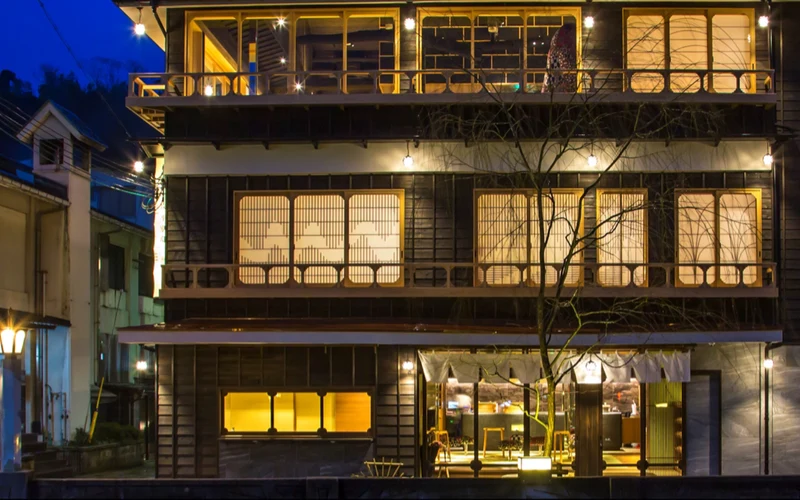
Kinosaki Onsen Ryokan: Which Inn to Book When the Town Is the Bath (2026)
Kinosaki Onsen hands every ryokan guest a free pass to its public bathhouses at check-in, which turns the usual hotel question inside out. This page compares nine inns on position, dinner and character — and prints which of the seven baths are actually open.
Five of the seven public baths are open, not seven. Satono-yu by the station has been shut since 1 April 2024 for a rebuild with no announced reopening, and Kono-yu is closed 11 May to 30 October 2026 — while the town's own marketing still advertises seven.
Your inn's bath matters far less than anywhere else. Every member ryokan gives guests a barcoded pass called the yumepa free at check-in: unlimited entry to the open public baths for the whole stay, valid to 13:00 on checkout day per Visit Kinosaki, though several inns and guides say 10:00 — confirm the time with your inn.
Not staying overnight? A one-day pass is ¥1,500 adult and ¥750 child on Visit Kinosaki's own FAQ, free under 3. A single bath on its own is ¥800 and ¥400.
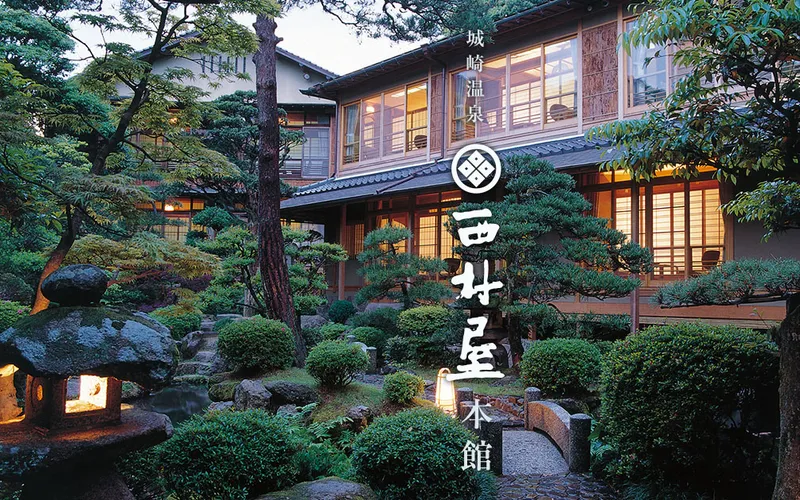
Nishimuraya Honkan is the one inn here whose own bath justifies the price — two bathhouses with indoor and open-air halves, minimum age 10. At the other end, Kinosaki Kojinmari appears to have no bath at all, and in this town that is survivable.
Tattoos are genuinely fine in the public baths — Visit Kinosaki states people with decorative tattoos are allowed in, no cover stickers. Its same FAQ warns individual inns set their own rules for their own baths, and not one of these nine publishes a policy.
Every rate you see quoted for Kinosaki is probably per person per night with kaiseki dinner and breakfast. Our snapshot rates are per room, room-only — the two numbers are not the same thing.
No car. The JR limited express Kinosaki runs from Kyoto in about 2h30 and the Kounotori from Shin-Osaka; both are all-reserved and both are covered by a JR Pass.
Bath closures, pass prices and hotel data checked August 2026. Nightly rates are a snapshot for 10–13 November 2026, two adults, room only.
Kinosaki Onsen Ryokan, Compared
One caution on the soak column. Every inn in Kinosaki draws the same municipal water, and every guest gets into the public baths free, so the water is never the differentiator. We use onsite only where the property has a bath of its own, and walk where the guest relies entirely on the public bathhouse pass.
None on the property that any source describes — the water you bathe in is the town's, at the public baths
No in-house onsen found on the official site or in our data. Unconfirmed rather than proven absent
The yumepa pass carries the entire stay: unlimited entry to the open sotoyu from check-in to checkout
4.8/5 (87)
$336
Nightly rates are snapshots pulled August 2026 for a 10–13 November 2026 stay, two adults, and they are per room with no meals. Kinosaki inns overwhelmingly quote per person per night with dinner and breakfast included, so a published ryokan rate will look nothing like these figures. Bath prices are in yen as Visit Kinosaki publishes them.
Which One Is for You
Position, dinner and character are the real decisions here. Nine inns, sorted by what you are actually choosing between.
All nine inns sit on the same town water and all nine hand out the same public-bath pass; the soak column tells you only whether the property also has a tub of its own worth walking to.
Source temperature
178°F / 81°C
One town source at 177.8°F, sodium-calcium chloride, cooled to about 108°F / 42°C in the baths. No per-bathhouse temperature is published anywhere.
When to soak
November–March
Crab season from the first catch in early November doubles rates and fills the town.
Day entry
Free for guests · ¥1,500 day
Staying at a member ryokan includes unlimited entry to the public sotoyu; day visitors pay ¥1,500 adult, ¥750 child. Checked August 2026.
Elevation
33 ft
Altitude shortens comfortable soaking time — drink water.
Kids
mixed
Jizo-yu keeps a lukewarm children's bath; Nishimuraya Honkan sets a minimum age of 10.
Nearest airport
Osaka (ITM)
About 180 minutes by road.
The Hotels, One by One
The inn with the best bath of its own first, then the small houses inside the bath circuit, then the two that lean entirely on the town's water.
The one bath worth paying for
Nishimuraya Honkan
4.6/5
Canal street by Yosho Shrine, about 12 minutes' walk from the station · 735 Google reviews
Hot springs on-site
Water
The town's single shared source, 177.8°F at the wellhead, cooled with added water to about 108°F / 42°C in the baths
Pools
Two large guest onsen with indoor and open-air sections, an annex indoor bath facing the garden, and private open-air tubs in some rooms
Room includes
In-house baths included; the free yumepa pass covers the public sotoyu from check-in to checkout
Kids
Ages 10+
Visit Kinosaki describes it as a "Traditional Japanese-style inn with over 165 years of history" and "a proud member of Relais & Châteaux and rated as the 'Best Onsen Ryokan' in the Lonely Planet Japan travel guide".
The only property in this set where the in-house bath is a reason to book rather than a footnote: two bathhouses with indoor and open-air halves, plus an annex bath over the garden.
Minimum guest age is 10, so this is a couples' and adults' house. Families should read Morizuya or Onishiya Suishoen instead.
Steps from Ichino-yu and its cave bath, four minutes from Yosho Shrine — you can be in a public bath ninety seconds after changing into the yukata.
Mid-shopping street, 7 minutes' walk from the station · 491 Google reviews
Hot springs on-site
Water
Same town source as everywhere here — 177.8°F at the wellhead, baths run near 108°F / 42°C
Pools
Two bath facilities, one an open-air bath carved from the bedrock of the hill behind the inn
Room includes
Baths usable privately at stated times (weekdays until about 18:30); yumepa pass for the sotoyu
Kids
All ages
Visit Kinosaki calls it an "Open air bath carved from the bedrock of the back mountain's slope. This cave like bath is popular among guests." — the most unusual in-house bath among the town's smaller inns.
The highest guest rating in this comparison, and the review topics that carry it are service, dining and family rather than the bath.
Eleven rooms in the middle of the shopping street, so the sotoyu circuit starts at the front door.
Google's summary records dinner and breakfast as a surcharge, which means the room and the kaiseki can be booked separately here.
Among the shops in the town centre, 13 minutes from the station · 258 Google reviews
Hot springs on-site
Water
Town source, 177.8°F at the wellhead, cooled to roughly 108°F / 42°C for bathing
Pools
Three complimentary private baths — Kagen, Chikuyo and Kirara, the last with an open-air feel. No large communal bath advertised
Room includes
Private baths free to guests; yumepa pass for the public baths; free station shuttle on request
Kids
All ages
The inn's own English page says plainly: "Tajimaya features 3 complimentary private baths" — one of them open-air, all included, none of them charged by the hour.
An early-1900s wooden building in the thick of the shops, which is where you want to be at 21:00 when the bathhouse queues thin out.
For a couple who want the water to themselves without Nishimuraya money, this is the pick.
Google's summary lists breakfast and dinner as complimentary — the standard tell that the quoted rate is per person with two meals folded in.
Leafy residential pocket at the upper end of town, 2 minutes from the ropeway · 160 Google reviews
Hot springs on-site
Water
Sodium chloride / calcium chloride water; the inn states the source is 177.8°F and that it adds water to bring the temperature down
Pools
Main building indoor bathhouse with two private baths; the UTSUROI annex has lock-the-door private baths, 15:00–23:00 and 07:00–10:00, not reservable
Room includes
Annex guests may also use the main building's baths; yumepa pass for the sotoyu
Kids
All ages
The clearest first-party water statement in town: the inn's annex site says the Kinosaki source runs 177.8°F and that they add water to adjust the temperature, and names the mineral class, "Sodium Chloride, Calcium Chloride, Hot Springs".
One of the few inns here with a genuine room-only plan — Visit Kinosaki lists a "【Main Building - Accommodation Only】" plan alongside the two-meal kaiseki plan.
Two linked properties: the main building six minutes from Ichino-yu, and UTSUROI, a five-room annex opened October 2018 at the end of the main street by Mandara-yu.
Annex baths are not gender-separated — you lock the door from inside — and they cannot be booked ahead.
Quiet side street off the main avenue, 6 minutes from Yosho Shrine · 566 Google reviews
Hot springs on-site
Water
Town source, 177.8°F at the wellhead, cooled to about 108°F / 42°C
Pools
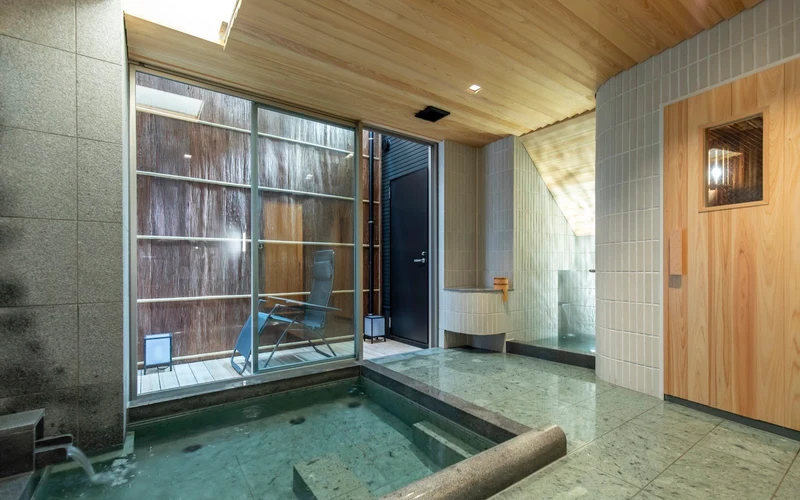
No communal bath. Two named private baths — the Porcelain Bath and the Cypress Bath — plus a private sauna by reservation
Room includes
Private baths free and unlimited during the stay; yumepa pass for the sotoyu. Late check-in at 17:00
Kids
All ages
Its own site: "Our private baths, the 'Porcelain Bath', and the 'Cyprus Bath', all can be used for free and as many times as you want during your stay." No large communal bath exists here at all.
That would be a defect in Hakone or Beppu. In Kinosaki it is a design choice — the five open public baths are the grand baths, and this inn simply skipped building a sixth.
Meals are served in the restaurant, not in the guest room: "All hotel-provided morning and evening meals are prepared and served in the restaurant."
Check-in is 17:00, later than every other inn here, which matters if you were planning to bathe before a 18:00 dinner.
Middle of the bath circuit, 7 minutes from the station · 335 Google reviews
Hot springs on-site
Water
Town source, 177.8°F at the wellhead, baths held near 108°F / 42°C
Pools
Gender-segregated communal bathhouses available 24 hours, one reservable private bath, and 6 of the 15 rooms with a bath of their own
Room includes
In-house baths included; yumepa pass for the sotoyu
Kids
All ages
Its own site confirms "gender-segregated, communal bathhouses with hot spring water", and the house bath runs 24 hours — useful when the sotoyu all shut at 23:00.
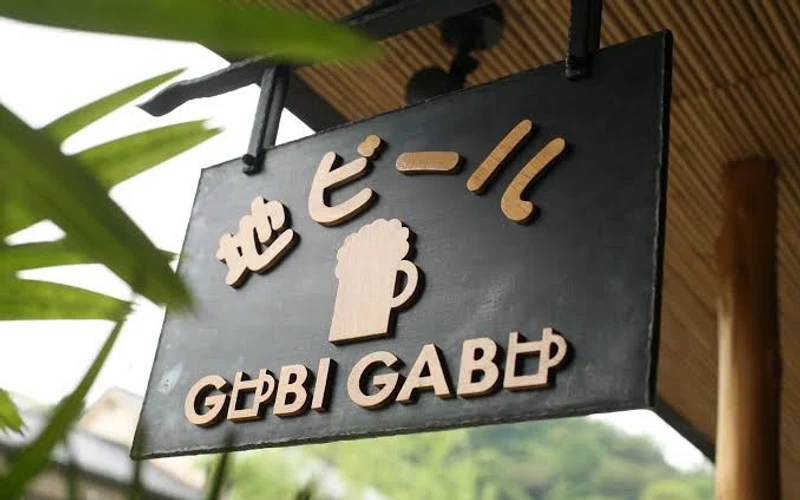
Visit Kinosaki's line on it: "Centrally located in the hot spring town, perfect for touring the public hot springs. Great place to taste the locally brewed beer."
Google's data says standard rooms have shared bathrooms while 6 of 15 rooms have their own bath — read the room type carefully before booking.
Restaurant, bar and tea room on site, which is rarer here than it sounds; most inns feed you in your room and close the shutters.
Momoshima, about 1 km from the station — outside the old town · 763 Google reviews
Hot springs on-site
Water
Town source, 177.8°F at the wellhead, cooled to roughly 108°F / 42°C
Pools
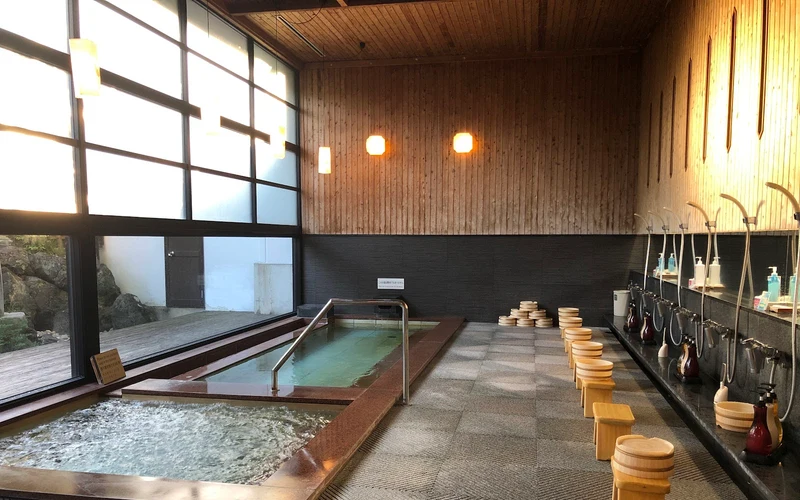
Gender-segregated large indoor baths with a jacuzzi, an open-air hot spring bath and saunas. No private or in-room baths
Room includes
In-house baths included; Visit Kinosaki states all plans include free public-bath tickets; free shuttle into town roughly 16:00–22:00
Kids
All ages
The only property here genuinely outside the old town — set in San'in Kaigan National Park a minute from the Maruyama River, about 1 km from the station.
That distance is real: the canal street is a walk, not a stroll in geta. The free shuttle between roughly 16:00 and 22:00 is what makes the sotoyu circuit workable.
In exchange you get the largest grounds in this comparison — a Noh stage and torches in the central garden, big indoor baths with a jacuzzi, an open-air bath, sauna and loaner bikes.
The most internationally bookable inn in the set, with a live Booking.com listing — though still no Expedia record in our data.
Yanagi-dori, the willow street, in the town centre · 220 Google reviews
Walk to the springs
Water
Its Japanese site advertises 源泉かけ流し — free-flowing source water — but describes no communal bath; our data recorded no bathing claims at all
Pools
Unverified. No large communal bath is described on the official site; a third-party listing claims a free hot spring bath
Room includes
Treat the in-house bathing setup as unconfirmed and plan on the yumepa pass and the public baths
Kids
Not published — third-party listings claim adults-only, unconfirmed
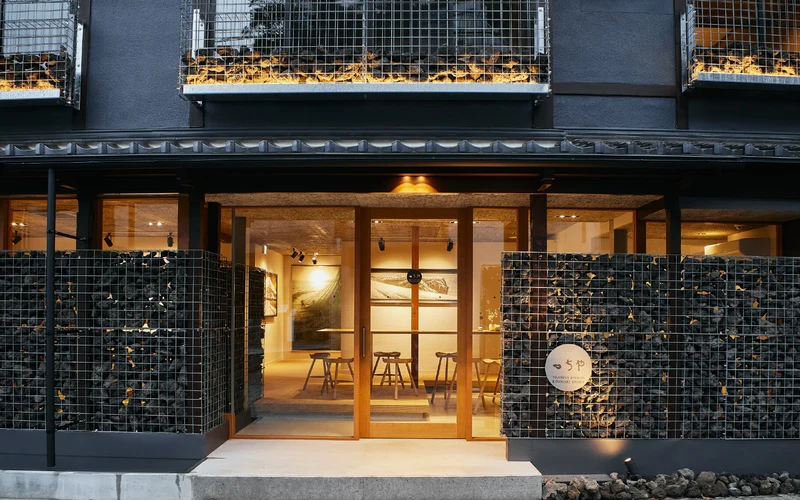
The least traditional house in this set: a design-led small property with a bar, table service and a breakfast buffet rather than kaiseki trays in the room.
It also leans hardest on the town's baths. Its own site advertises free-flowing source water but describes no 大浴場, and our harvest recorded no bathing claims — we are not going to assert a bath either way.
Position is the argument: Yanagi-dori puts you on the willow street beside Yanagi-yu, with Ichino-yu and Jizo-yu inside five minutes.
Reservations run through its own site or by phone; the English version of its website returned a 404 when we tried it.
None on the property that any source describes — the water you bathe in is the town's, at the public baths
Pools
No in-house onsen found on the official site or in our data. Unconfirmed rather than proven absent
Room includes
The yumepa pass carries the entire stay: unlimited entry to the open sotoyu from check-in to checkout
Kids
Not published
Calls itself "The inn smallest at Kinosaki" and publishes almost nothing else — no bath, no meal plan, no rate.
It is the clearest proof of how this town works: you can book a room with no onsen at all and still bathe in five historic bathhouses for nothing.
The only property in our whole data set that returned a rate at all, and it comes with no stated meal basis — do not read it as comparable to a per-person two-meal ryokan price.
Rated highly by a small number of guests, with location and atmosphere leading the review topics.
Rates shown are room-only snapshots for 10–13 November 2026, two adults, checked August 2026 — not the per-person kaiseki rates the inns themselves publish. Booking through links on this page may earn us a commission at no extra cost to you.
Prefer to browse everything bookable in Kinosaki Onsen? Search all stays:
Where the Water Actually Is
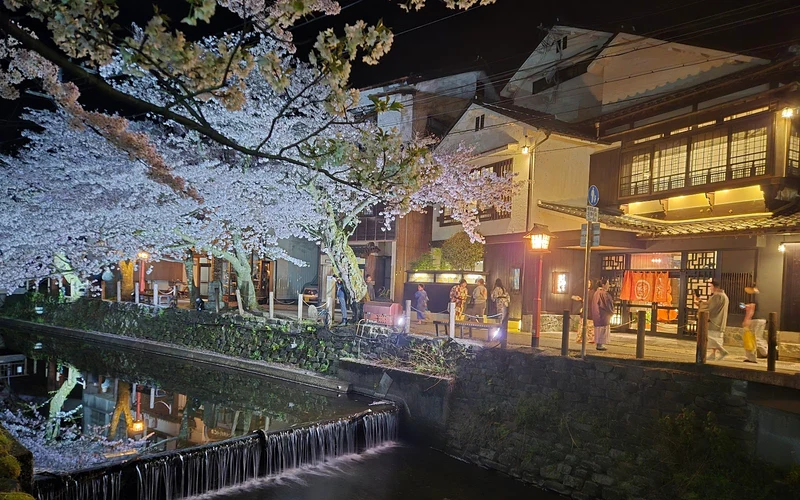
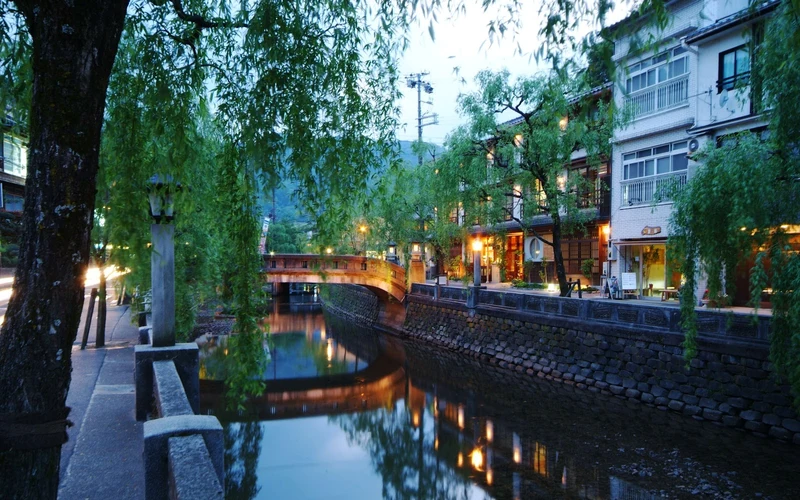
The water is in the streets, not in the hotels. Seven public bathhouses stand along the willow-lined canal and up the side lanes, five of them currently open, and the inns are arranged around them like rooms around a corridor.
The canal street and the bath circuit
open bathhouses, all within a 15-minute walk
Goshono-yu — multi-level open-air bath against a rock waterfall, granite bench, steam sauna. 7:00–23:00, closed ThursdayIchino-yu — Kabuki-facade bathhouse with outdoor baths inside a rock cave and private family baths. 7:00–23:00, closed WednesdayJizo-yu — high-ceilinged local bath with a shallow lukewarm children's pool and family baths. 7:00–23:00, closed MondayYanagi-yu — the smallest of the seven, wooden tubs, street-side foot bath. 15:00–23:00, closed ThursdayMandara-yu — the only one off the main road, two outdoor ceramic tubs facing the mountain. 15:00–23:00, closed Wednesday
Each bathhouse closes on a different weekday, so a two-night stay can cover four or five of them if you plan the order. Goshono-yu and Yanagi-yu both close Thursday; Ichino-yu and Mandara-yu both close Wednesday.
Closed bathhouses
two of the seven, as of August 2026
Satono-yu, by the station — the rooftop open-air bath and herb sauna. Closed since 1 April 2024 for a rebuild, no announced reopening dateKono-yu, at the quiet end of the valley — the oldest building in town, garden open-air bath. Closed 11 May to 30 October 2026 for renovation
Visit Kinosaki's marketing pages, its FAQ and its pass pricing all still say seven. Its own bathhouse pages say otherwise, and we have not found any statement on whether the ¥1,500 day pass was reduced while two are shut.
Momoshima, across toward the river
about 1 km out, free shuttle from 16:00
No public bathhouse in this pocket — the inn's own baths, then a shuttle into the circuit
This is a real walk in shoes, not a stroll in geta. The shuttle running roughly 16:00 to 22:00 is what keeps the bath circuit in reach.
⟷From Tajimaya or Nishimuraya Honkan you are steps from Ichino-yu and its cave bath; both sit at the upper, quieter end of the canal street.
⟷Kinosaki Onsen Tokitotoki sits on Yanagi-dori beside Yanagi-yu, which opens only from 15:00 — pair it with Jizo-yu for a morning bath instead.
⟷From Onishiya Suishoen nothing on the circuit is a short walk. Take the shuttle in, bathe, eat, and come back on it.
hot springs on-sitewalk to the springsdrive to the springsno thermal water
Kinosaki Onsen by the Numbers
Figures below come from Visit Kinosaki's own bathhouse and FAQ pages, plus one inn's published water data, all read in August 2026. Where the town's pages contradict each other, both readings are printed.
Public baths open
5 of 7
Satono-yu closed since 1 April 2024 for a rebuild; Kono-yu closed 11 May to 30 October 2026. Visit Kinosaki's marketing still says seven.
Source temperature
177.8°F
Published by Tsuchiya's annex site — "the hot spring source for Kinosaki Onsen is very hot" — which also states that water is added to bring it down.
Bathing temperature
about 108°F / 42°C
Town-wide figure, cooled from the source. No per-bathhouse temperature is published anywhere; anyone quoting one is guessing.
One-day pass
¥1,500 adult / ¥750 child
Visit Kinosaki's FAQ, for visitors not staying overnight; free under 3. Older third-party pages still show ¥1,300 / ¥650.
Single bath entry
¥800 adult / ¥400 child
Same at every open bathhouse. Satono-yu was the one exception at ¥900 / ¥450 when it operated.
Ropeway, round trip
¥1,200 adult / ¥600 child
To the summit of Mount Daishi; ¥750 / ¥370 to the middle station and Onsenji temple. Open 09:10–16:50, last ride up 16:30.
The Pass Turns the Usual Question Inside Out
On every other page of this site the question is whether the hotel has the water. In Kinosaki that question nearly stops mattering. Check into a member ryokan and you are handed a barcoded pass called the yumepa — free, no deposit, no per-entry charge. Scan it at the gate of any open public bathhouse, as many times as you like, from check-in until you leave. Visit Kinosaki states it is valid until 13:00 on the day of checkout. Several inns and third-party guides say 10:00 instead, and both figures are on the record, so the honest answer is that it probably varies by inn and you should ask yours.
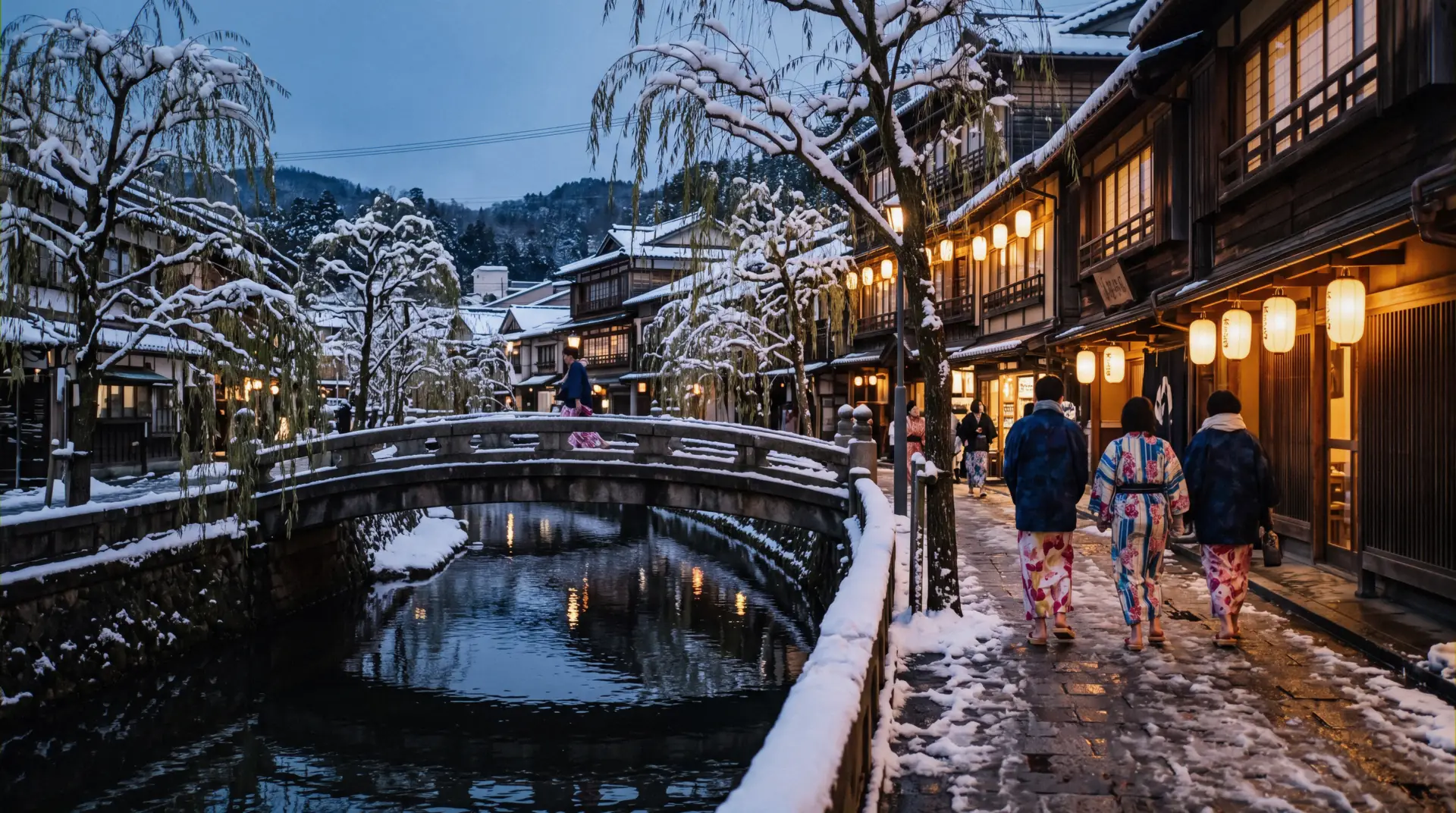
The public bathhouses have a name, sotoyu, and so does the ritual of walking between them: sotoyu meguri. Historically most Kinosaki inns had no bath of their own, so since the Edo period guests have changed into the yukata and geta the inn provides and walked out into the street to bathe. The town describes the arrangement without much modesty — the inns are the guest rooms, the streets are the corridors, the bathhouses are the grand baths. Yukata on the canal bridges is not a costume here; it reads as an announcement that you are a guest of one of the inns.
So the in-house bath drops down the list. Kinosaki Onsen Sensui has no communal bath whatsoever, only two free private ones, and it holds one of the strongest guest ratings in town. Kinosaki Kojinmari — which calls itself the smallest inn in Kinosaki — describes no bath at all on its own website, and that is a survivable condition here rather than a disqualification. The one property where the bath is a genuine reason to book is Nishimuraya Honkan, with two bathhouses of its own, each with indoor and open-air halves, and private open-air tubs in some rooms. Everywhere else, choose on position, on dinner, and on what the house feels like.
Five of the Seven Are Open — Not Seven
This is the most useful thing on this page, and it contradicts the town's own advertising. Kinosaki markets itself on seven public hot spring baths. As of August 2026, five of them are open.
Satono-yu, the modern complex right beside Kinosaki Onsen station with the third-floor rooftop bath and the herb sauna, has been closed since 1 April 2024. Visit Kinosaki's page for it says only that it is indefinitely closed for renovations. Secondary reporting says asbestos was found during demolition and that the city now projects a reopening several years out; we could not confirm that from any primary source, so we are not printing a year. Closed since April 2024, no announced reopening, is the whole verifiable statement.
Kono-yu, the oldest bathhouse building in town at the far quiet end of the valley — the one with the stork legend and the garden open-air bath — is closed 11 May to 30 October 2026 for renovation work. Its own page on Visit Kinosaki says so plainly, while the site's front page and FAQ carry on advertising seven tattoo-friendly baths and pricing a pass to match. We have found nothing stating whether the ¥1,500 day pass was reduced while two are shut. Check at the gate.
The five that are open each close on a different weekday, which is the actual planning constraint. Two nights covers four or five of them if you sequence it; one night at the wrong end of the week can leave you with three.
Goshono-yu — 7:00–23:00, closed Thursday. Multi-level open-air bath against a rock waterfall, granite bench, steam sauna. The best of them.
Ichino-yu — 7:00–23:00, closed Wednesday. Kabuki-theatre facade, outdoor baths inside a rock cave, private family baths.
Jizo-yu — 7:00–23:00, closed Monday. High-ceilinged neighbourhood bath with a shallow lukewarm children's pool and family baths. The one to bring small children to.
Yanagi-yu — 15:00–23:00, closed Thursday. The smallest of the seven, wooden tubs, foot bath on the street outside.
Mandara-yu — 15:00–23:00, closed Wednesday. The only bathhouse off the main road, with two small outdoor ceramic tubs facing the mountainside.
Kono-yu — 7:00–23:00, closed Tuesday, and closed entirely 11 May to 30 October 2026.
Satono-yu — closed since 1 April 2024, no reopening date published.
Why Every Kinosaki Price Looks Wrong
Ryokan pricing in Kinosaki follows the Japanese convention, and it catches out almost every visitor booking from abroad. Rates are quoted per person per night, with a multi-course kaiseki dinner and a Japanese breakfast included. Visit Kinosaki's own booking engine prints exactly that — an amount per person per night, with dinner and breakfast included — and lists lodging with breakfast, and lodging with no meals, as separate plan types further down.
The nightly figures in our comparison table are the opposite: per room, room only, snapshotted for a 10–13 November 2026 stay with two adults. Set them beside a ryokan's published rate and the ryokan will look like double or triple the price when in fact it is feeding two people twice. Read the meal basis before you compare anything.
Room-only plans do exist here, and they are the ones that compare cleanly. Tsuchiya Ryokan publishes an accommodation-only plan for its main building alongside the seasonal kaiseki plan. Onishiya Suishoen and Morizuya Inn both record meals as an arrangeable surcharge rather than a fixture. Kiraku, a small inn a minute from Goshono-yu that did not make the cards here, includes breakfast and charges separately for dinner. Everywhere else, assume two meals are baked in.
There is a second reason to care. The dinner is not incidental to the price — it is most of it. From the first snow crab catch in early November through to about late March, the kaiseki is built around matsuba crab, and that single ingredient is what roughly doubles winter rates. Outside crab season the headline becomes Tajima beef, the same bloodline as Kobe, and the rate falls with it.
Tattoos: The Baths Say Yes, the Inns Say Nothing
Kinosaki is one of the very few Japanese onsen towns with a published, town-wide, tattoo-OK policy, and it does not hedge. Visit Kinosaki's FAQ states that people with decorative tattoos are allowed into the public hot springs, and the site's front page fronts the town as famous for its tattoo-friendly natural hot spring baths. No cover-up stickers, no size limit stated, no separate hours. If a tattoo has kept you out of onsen elsewhere in Japan, this town is the answer to that problem.
The caveat comes from the same FAQ and it is not a technicality: some accommodations have different rules regarding their own in-house baths. The public bathhouses are settled; your inn's private bath is a separate decision made by the inn.
Here is the gap we will not paper over. Not one of the nine inns on this page publishes a tattoo policy on its own website. Not the Relais & Châteaux flagship, not the small houses, not the design-led newcomer. We searched for it and found nothing either way. So the accurate position is this: the five open sotoyu will take you, and every in-house bath in this comparison is unknown until you ask the inn directly at booking. Given that the pass covers the public baths for the entire stay, that unknown costs you very little in practice — but it is worth one email if the inn's own bath is part of why you chose it.
Getting There, and When the Town Is Worth the Fare
Do not rent a car. Kinosaki Onsen station is a direct limited-express ride, the old street is narrow, parking is an inn-by-inn arrangement, and the entire town — five open bathhouses, the ropeway, the restaurants — sits inside a 15-minute walk. From Kyoto, the JR Limited Express Kinosaki runs straight through on the San'in Main Line in roughly two and a half hours, about five round trips a day, every seat reserved with no unreserved cars. From Shin-Osaka, the Limited Express Kounotori comes via Fukuchiyama, also all-reserved. Sannomiya and Himeji have limited-express service too. A JR Pass or JR West Rail Pass covers all of these — it does not cover the KTR line, so routing in via Amanohashidate means buying a ticket at the station.
The inns sit between about 3 and 14 minutes' walk from the station, and several — Tajimaya, Tsukimotoya, Kiraku and Onishiya Suishoen — run a free station shuttle, which is the practical answer to dragging a suitcase over the canal bridges. Carry wheeled luggage across tatami rather than rolling it, and expect to leave your shoes at the inn's entrance.
On timing, the water does not change with the season — it is held near 108°F / 42°C year-round, cooled from a source that comes out of the ground at 177.8°F. The town changes, and so does the dinner. November through March is crab season and the reason most Japanese guests come; it is when snow sits on the willows and when rates are highest. Autumn foliage in November overlaps the opening of crab season, the busiest combination of the year, so book months out. Summer is quietest and cheapest, though a 108°F / 42°C bath on a humid Kansai August evening is an acquired taste. Whenever you come, most inns serve dinner around 18:00, so check in early enough to bathe first.
Book the limited express seat in advance — these trains have no unreserved cars.
Check which bathhouses close on your dates before you fix the itinerary; each has a different weekday closure.
The ropeway up Mount Daishi runs 09:10–16:50, last ride up 16:30, ¥1,200 round trip to the summit.
Arrive by mid-afternoon: dinner is around 18:00 and the two afternoon-only bathhouses open at 15:00.
How This Page Was Put Together
Bathhouse hours, closing days, entry prices and the tattoo and pass policies come from Visit Kinosaki's own pages — the individual bathhouse pages, the visitor FAQ and the ryokan-etiquette guide — read in August 2026 and quoted rather than paraphrased where the wording carries weight. The water data comes from Tsuchiya's annex site, the only property here publishing a source temperature and mineral class. Hotel ratings, review counts and rates come from a Google Hotels data pull the same month, snapshotted for a 10–13 November 2026 stay, two adults, room only.
One coverage gap needs naming plainly. All twelve harvested properties returned no Expedia record and no OTA rate rows, so every card on this page links to an Expedia search for the town rather than to the property itself. That is our gap, not proof the inns are unbookable: Nishimuraya Honkan and Onishiya Suishoen both have live Booking.com and Agoda listings. For several of the smaller houses we could not confirm any international listing at all, and those may genuinely sell direct or through Japanese channels only. Check the inn's own site before you assume a room is available.
Six URLs returned 404 during research, including three bathhouse pages and the English version of one inn's website; working equivalents were found for every material fact. The official site has a slug trap worth knowing if you go looking yourself — accommodation pages use underscores rather than hyphens, so the hyphenated forms fall back silently to the accommodations index instead of erroring.
Known gaps, stated rather than smoothed over. No per-bathhouse water temperature exists in any source; only the town-wide figures do. Satono-yu's reopening year is secondary-source only and is not printed here. The yumepa's checkout-day validity is 13:00 on Visit Kinosaki and 10:00 in several other places. Tokitotoki's in-house bathing setup could not be confirmed either way, and Tsukimotoya — not carded here — is described by Google as charging a fee for its own communal bath while the town's listing mentions none. No inn in this comparison publishes a tattoo policy for its own baths. And the single rate figure that appeared in our data, for the smallest inn in town, carries no stated meal basis at all.
Kinosaki Onsen Ryokan: Questions
Is the public bath pass really free with a ryokan stay?
Yes. Member inns give guests a barcoded yumepa pass at check-in at no charge, and it admits you to the open public bathhouses as many times as you want for the length of the stay. Visit Kinosaki says it stays valid until 13:00 on checkout day, though several inns and guides quote 10:00, so confirm with yours. Day visitors who are not staying overnight pay ¥1,500 for an adult one-day pass instead.
Are all seven Kinosaki Onsen baths open?
No — five are. Satono-yu beside the station has been closed since 1 April 2024 for a rebuild with no announced reopening, and Kono-yu is closed from 11 May to 30 October 2026 for renovation. The town's own marketing pages still advertise seven, so check the rota before you plan an evening. The five open bathhouses each close on a different weekday.
Are tattoos allowed in Kinosaki Onsen?
In the public baths, yes, and unusually for Japan the town says so in writing: Visit Kinosaki states that people with decorative tattoos are allowed into its public hot springs, with no cover-up stickers required. Its own FAQ warns that individual inns set separate rules for their in-house baths, and none of the inns on this page publishes one. Ask your inn directly if its own bath is part of why you booked it.
Do I need a ryokan with its own bath in Kinosaki?
Not really, and that is what makes this town different. The free pass covers the public bathhouses for your whole stay, so an inn's own tub is a convenience rather than the point — useful late at night, since the sotoyu all close at 23:00. Kinosaki Onsen Sensui has no communal bath at all and rates highly regardless. If you do want a bath worth staying in for, Nishimuraya Honkan is the one.
Why are Kinosaki ryokan prices quoted per person?
Because the Japanese convention prices the stay per person per night with a kaiseki dinner and breakfast included, and Visit Kinosaki's booking engine prints it that way. The rates in our table are the opposite — per room, room only — so they are not comparable without that adjustment. A few inns do publish room-only plans, which are the ones you can put side by side.
Do I need a car to visit Kinosaki Onsen?
No, and a car is closer to a liability. The limited express Kinosaki reaches the town from Kyoto in about two and a half hours and the Kounotori runs from Shin-Osaka; both are all-reserved and both are covered by a JR Pass, which does not extend to the KTR line. Once you arrive, the bathhouses, restaurants and ropeway are all within a 15-minute walk, and several inns run a free station shuttle.
When is the best time to visit Kinosaki Onsen?
November to March if you are coming for the food — matsuba snow crab season opens with the first catch in early November and the kaiseki is built around it, which is also why rates roughly double. Outside that window the dinner headline is Tajima beef and prices fall. The bath temperature does not move with the season: it is held near 108°F / 42°C all year, cooled from a 177.8°F source.