Hakone Onsen Ryokan: Where the Water Is, and Who Can Get In It
Hakone sits 80 minutes from Shinjuku on 17 registered hot-spring districts, and a Hakone onsen ryokan will sell you a room, two kaiseki meals and a bath in the same price. What almost none of them will tell you in English is whether you are allowed in that bath with a tattoo.
Ten of the twelve ryokan we checked publish nothing at all about tattoos. That is silence, not permission — the honest label is "not published, ask before booking", and it is the single most useful line on this page.
Two lodgings do publish a rule, both requiring cover seals: Yoshiike Ryokan since 1 December 2023, and Tensui Saryo through its operator. Both sell the seals at ¥250 each. Details in tattoos, in three tiers.
Staying elsewhere? Hakone Yuryo dropped its tattoo restriction outright on 1 April 2025 and Tenzan Tohji-kyo admits one tattooed bather at a time — see bathing without a room, where day passes start at ¥1,400.
An onsen is a legal category, not a marketing word: 77°F / 25°C at the source, or one of 19 listed minerals. Water that is filtered and pumped back round is not what Japanese guests are looking for — the word for the good stuff is kakenagashi.
Every rate in the table is per room and room-only. A real ryokan sells per person with kaiseki dinner and breakfast, ¥15,000–30,000 a head nationally. Hakone Retreat is the one property here confirmed to quote per room — read why the prices look wrong before you compare anything.
No car. The Hakone Freepass is ¥7,100 for two days from Shinjuku and covers eight modes of transport around the loop.
Hotel data and prices checked August 2026. Nightly rates are a snapshot for 10–13 November 2026, two adults.
Hakone Onsen Ryokan, Compared
Nine inns, all with hot spring water on site. Read the bath column first — a private open-air tub in your own room is a different purchase from the right to use the shared baths downstairs, and in Hakone that difference is most of the price.
Two hot-spring sources feeding the main bathhouse Gyokukei-no-Yu; Gora district sources run 86–199°F / 30–93°C
A hinoki cypress open-air bath in all 158 rooms, several indoor baths, the large outdoor bath Kakabi, and three reservable baths — Hanagasumi, Kangetsu and Manten
In-room cypress bath plus the full bathhouse; the three private baths are reserved separately
Communal bathhouse with geothermal water; Sengokuhara is not in the tourist board's four-district breakdown, so no source count or temperature is published for it
18 free-standing villas, each with a private temperature-controlled indoor or open-air bath, plus a communal bathhouse; premium suites add sky open-air baths
Villa bath plus the communal bathhouse; bicycles, two restaurants and a bakery on the estate
Alkaline simple hot spring — "アルカリ性単純温泉(汚れおとし、肌すべすべ)", the soft skin-smoothing type. Source temperature not published
Communal indoor and open-air baths, gorge-side rooms with their own open-air tub, and a stained-glass private family bath with a Taisho-era Italian marble tub
Communal baths included; the family bath goes to overnight guests first, by arrangement
4.3/5 (785)
$204
Rates are a snapshot for 10–13 November 2026, two adults, gathered August 2026, and they are per room and room-only from the booking sites. Most of these properties actually sell per person with dinner and breakfast, so the two numbers are not the same product. Ginyu, Madoka no Mori and Gora Kadan publish no rate at all and take bookings direct.
Which One Is for You
Everything here has real hot spring water. What separates them is whether the bath is in your room, how honest the property is about who may use it, and how far you have to walk from a train.
Nine onsen ryokan across four Hakone districts — here they are side by side.
Source temperature
171°F / 77°C
Hakone-Yumoto's 74 sources run 73–171°F / 23–77°C; Kowakudani reaches 205°F / 96°C and Gora 199°F / 93°C. Baths are blended down.
When to soak
Year-round
Autumn maples and winter steam are the draw; no car needed — the Hakone Freepass covers eight transport modes.
Day entry
¥1,350–2,900 day use
Tenzan, Hakone Yuryo and Yunessun sell day bathing; Yunessun's own price and the reported one differ. Checked August 2026.
Elevation
2,300 ft
Altitude shortens comfortable soaking time — drink water.
Kids
mixed
Communal bathing is nude and gender-separated; rooms with private open-air baths are the family and tattoo answer.
Nearest airport
Tokyo (HND)
About 100 minutes by road.
The Hotels, One by One
Ordered by how completely each one solves the bath question: the every-room-private-onsen houses first, then the properties whose water or policy is documented in their own words, then the useful outliers. Japanese quotations come from each property's own site; where nothing is published, the card says so.
Free-flowing bath in all 23 rooms
Hakone Suishoen
4.5/5
Kowakudani, inside the 1925 Mitsui Suishoen estate, 13 minutes' walk from Kowakidani station · 456 Google reviews
Hot springs on-site
Water
Weakly alkaline simple hot spring — the inn's own line is "お湯は肌にやさしい弱アルカリ性の単純温泉"; Kowakudani district sources run 104–205°F / 40–96°C
Pools
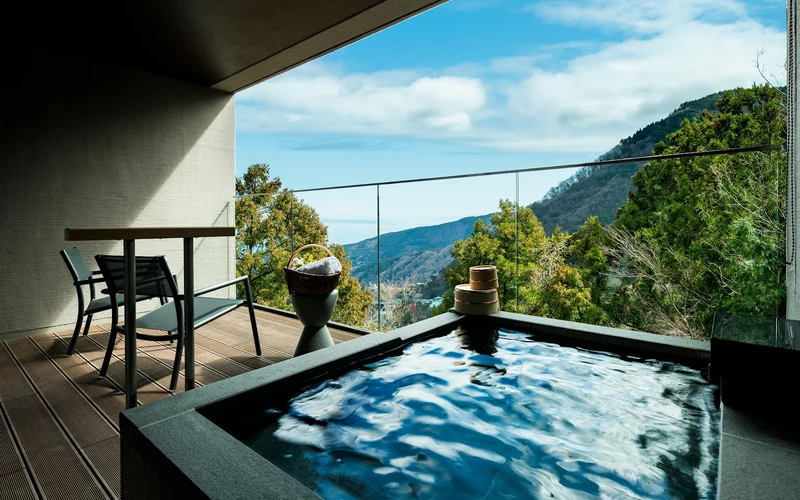
A private open-air bath in every one of the 23 rooms, plus a communal bathhouse with geothermal water
Room includes
In-room rotenburo around the clock; communal bathhouse, spa and a free station shuttle included
Kids
Listed as kid-friendly; no age rule published
The strongest free-flowing claim on this page, written in Japanese on the inn's own site: "全室源泉かけ流し露天風呂のお部屋" — every room's open-air bath is fed straight from the source, not filtered and recirculated. No English listing carries that sentence.
Twenty-three rooms inside a registered historic estate built in 1925, with a kaiseki restaurant and a teppanyaki room on site.
Tattoo policy is not published anywhere on its own site — ask before using the communal bathhouse. The in-room bath removes the question for the rest of the stay; see how tattoos actually work in Hakone.
Rates on the OTAs are per room; the inn's own quote is per person with kaiseki dinner and breakfast, which is a different product entirely — see why the prices look wrong.
Gora, in woodland about 1 km from Hakone Gora Park · 484 Google reviews
Hot springs on-site
Water
Two proprietary hot-spring sources; the house states "源泉掛け流し" — free-flowing, no reuse. Gora district sources run 86–199°F / 30–93°C
Pools
A private open-air onsen in all 20 rooms, a shared bathhouse with natural hot spring water, and a heated bedrock bath for a fee
Room includes
In-room bath plus the shared bathhouse; dinner and breakfast are included in the rate
Kids
Listed as kid-friendly, but the house reads adults-first
The highest-rated property in this set, and the smallest of the every-room-bath group at 20 rooms — a lounge with a hearth, a bar and woodland on three sides.
One of only three Hakone properties whose free-flowing claim we could read in Japanese on its own site, alongside Hakone Suishoen and Yoshiike Ryokan.
Dinner and breakfast are included and posted rates already carry service charge and tax — "掲載の料金は特に記載がない限り、サービス料・消費税が含まれております" — so its number is not comparable to a room-only city hotel rate.
No tattoo policy published. Record it as unknown, not permitted; the private bath in every room is the practical answer.
Miyanoshita, built into the cliff above the Hayakawa gorge, 4 minutes' walk from Miyanoshita station · 813 Google reviews
Hot springs on-site
Water
Sodium chloride spring, classified on the inn's own site as "ナトリウム-塩化物泉(低張性 弱アルカリ性 高温泉)" — hypotonic, weakly alkaline, high-temperature
Pools
An open-air onsen bath on every room's terrace, two communal open-air bathhouses with mountain views, and a sauna
Room includes
In-room rotenburo throughout the stay; both communal bathhouses and the sauna included
Kids
Listed as kid-friendly; no minimum age published
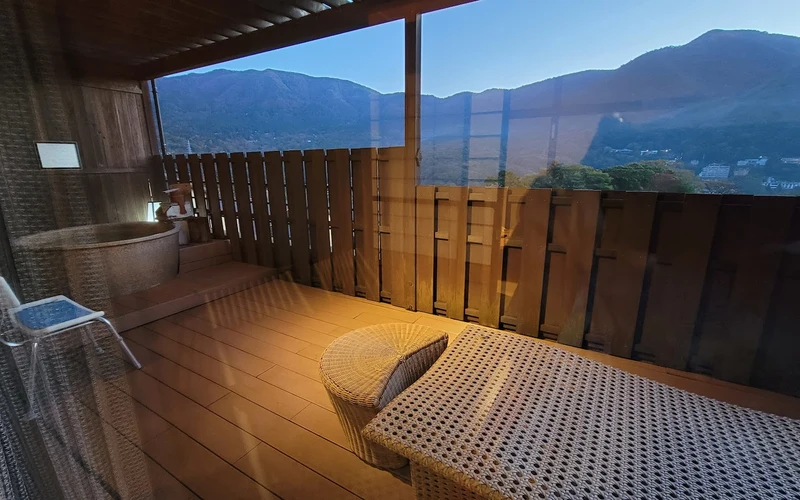
The clearest example on this page of what "room with onsen" should mean: "全室早川渓谷側に面したオープンテラスに温泉の露天風呂を設け" — all rooms, all facing the gorge, across the Kaze, Hoshi, Sora and Tsuki types.
Service is the standout in guest feedback by a wide margin, which is what a 3-star classification here fails to convey.
No public rates and no OTA listings in this harvest: booking is by phone (0460-82-3355). Treat it as a direct-booking house rather than an expensive one.
Also sells a daytime spa package — "10:15~13:30(3.25H滞在)GinyuSpa+ランチ" — if you want the water without the night.
Gora, uphill from the station on the Tozan line · 571 Google reviews
Hot springs on-site
Water
Gora supply; the district's 30 sources run 86–199°F / 30–93°C and part of it is "created" from Owakudani steam
Pools
A private open-air bath in all 70 rooms, two large view bathhouses, and three kashikiri (reservable) baths
Room includes
In-room bath plus both communal bathhouses; the three private baths are booked by slot
Kids
No age rule published
The large-scale version of the in-room-bath formula: 70 rooms of roughly 56 m², each with its own open-air bath, and three private baths on top — "プライベートを大切にしたいときは貸切風呂で" is the operator's own framing.
Room classes include a barrier-free Universal Room, which matters because step-free onsen lodging in Hakone is scarce.
The one property here that visibly sells room-only, breakfast-only and two-meal plans side by side on its own booking calendar, so its OTA rate is closer to an apples-to-apples figure than most.
Tattoo policy not published. Between a bath in every room and three reservable baths, a tattooed guest never has to enter the communal bathhouse.
Gora, one minute's walk from Gora station · 2,545 Google reviews
Hot springs on-site
Water
Two hot-spring sources feeding the main bathhouse Gyokukei-no-Yu; Gora district sources run 86–199°F / 30–93°C
Pools
A hinoki cypress open-air bath in all 158 rooms, several indoor baths, the large outdoor bath Kakabi, and three reservable baths — Hanagasumi, Kangetsu and Manten
Room includes
In-room cypress bath plus the full bathhouse; the three private baths are reserved separately
Kids
Family plans sold; no minimum age published
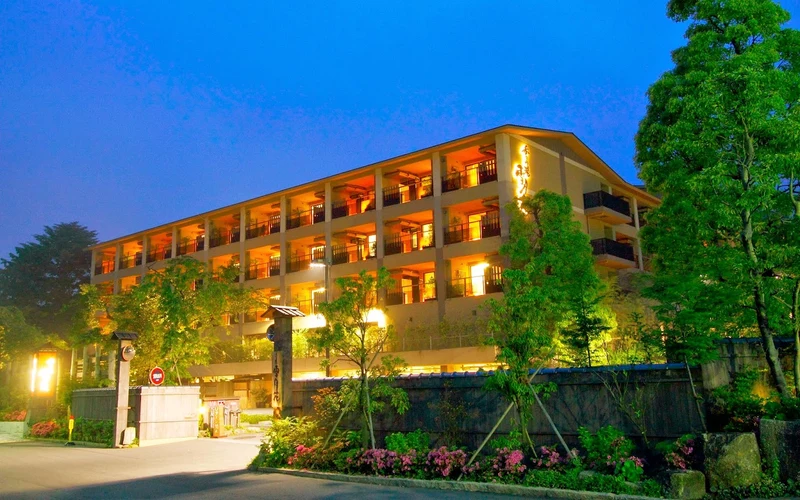
Sixty seconds from Gora station, which is the interchange of the whole Hakone loop — no other property here saves you that walk with luggage.
"All 158 guest rooms include cypress wood private open-air baths," per the operator, plus three kashikiri baths. Scale is the point, and also the reason the reviews are the most mixed on this page.
Two restaurants — kaiseki and hot pot at Kacho, wagyu shabu-shabu and sushi at Fugetsu — and a spa branded by BARAKA.
No tattoo policy published on the property page. Large chain onsen hotels in Japan commonly restrict; confirm before counting on the communal bath.
Hakone-Yumoto, gardens on the Sukumo river, 7 minutes' walk from the station · 1,359 Google reviews
Hot springs on-site
Water
Six proprietary sources at 109–176°F / 43–80°C, sodium-calcium chloride, pH 8.40, up to 720 litres a minute — "源泉掛け流し100%本物の天然温泉"
Pools
Indoor communal baths, garden open-air baths, and a spring-fed outdoor garden pool from 1 June to 30 September 2026
Room includes
All bathhouses included; day bathers admitted separately
Kids
All ages — child day-use rate published
Owns six springs outright — "6本の豊富な自家源泉からの天然温泉100%" — at up to 720 litres a minute. Nothing here is piped in from another operator's well, which on this list is rare.
The clearest tattoo policy of any lodging in Hakone, and it is dated: since 1 December 2023, tattoos covered by two 10×14 cm seals, sold at the front desk for ¥250 each, may use the large bath and the open-air bath.
Its own source figures do not fully agree — the onsen page gives six sources across 109–176°F / 43–80°C, while a secondary Japanese source cites a single 134.6°F. The range is the primary number.
Large and a little dated rather than boutique: a steakhouse and a nightclub share the building with the baths, and only upgraded rooms have their own soaking tub.
Gora, one minute from Gora station · 621 Google reviews
Hot springs on-site
Water
"2種の美肌温泉" — two skin-beautifying spring types; Gora district sources run 86–199°F / 30–93°C
Pools
Gender-separated communal bathhouses with indoor and open-air bathing, private tubs available, and a footbath at the cafe/bar
Room includes
Communal baths included; private tubs and craft workshops booked on site
Kids
Listed as kid-friendly; no minimum age published
One of only two lodgings in this set with a written tattoo rule. Its operator, Relo Hotels & Resorts, admits guests with tattoos to baths, pool, sauna and rotenburo if covered by two supplied 10×15 cm seals at ¥250 each — refusing to use them is grounds for denial.
Contemporary rather than traditional: a cafe/bar with a footbath, craft workshops, and a one-minute walk to the station.
Only some room classes have an open-air or glass-enclosed tub — do not assume; check the class you are booking.
Its own booking channel, booking.relohotels.com, came in cheaper than every OTA in this harvest. Worth a direct quote before you book elsewhere.
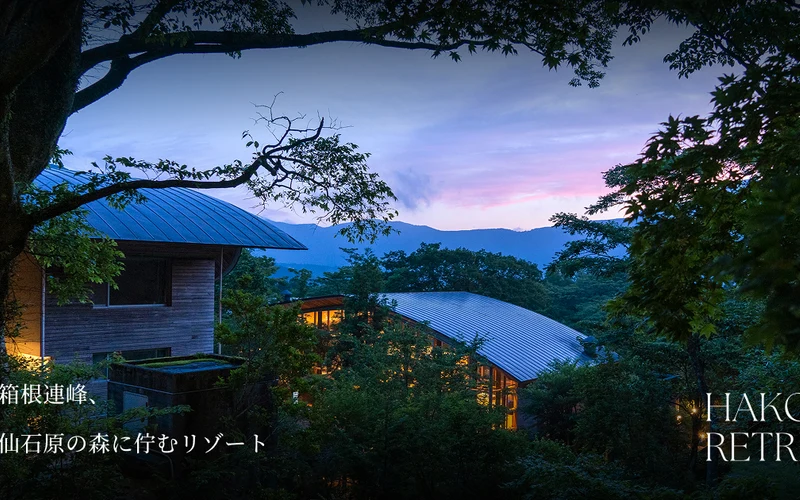
Sengokuhara, a wooded estate off Route 138, 4 minutes' walk from the Venetian Glass Museum · 177 Google reviews
Hot springs on-site
Water
Communal bathhouse with geothermal water; Sengokuhara is not in the tourist board's four-district breakdown, so no source count or temperature is published for it
Pools
18 free-standing villas, each with a private temperature-controlled indoor or open-air bath, plus a communal bathhouse; premium suites add sky open-air baths
Room includes
Villa bath plus the communal bathhouse; bicycles, two restaurants and a bakery on the estate
Kids
No age rule published; dogs allowed
The one property here confirmed to quote per villa rather than per person — its pricing convention actually matches the rates in the table above.
Also the sharpest argument on this page for checking more than one channel: for the same November stay, Agoda showed $456 while Expedia and Hotels.com showed $879, a $423 spread on one property.
The most foreigner-ready address in the set — English, Mandarin and Cantonese spoken, wood-burning stoves in the cottages, dogs welcome. The trade is transport: Sengokuhara is bus-only, no train, no cable car.
Its own site describes 温泉スイート「ゆらぎ」 suites and 天空露天温泉 sky baths; the aggregator summary is more cautious, saying only that some villas have open-air tubs. Both readings are in print.
Tonosawa, on the Hayakawa gorge one stop above Hakone-Yumoto · 785 Google reviews
Hot springs on-site
Water
Alkaline simple hot spring — "アルカリ性単純温泉(汚れおとし、肌すべすべ)", the soft skin-smoothing type. Source temperature not published
Pools
Communal indoor and open-air baths, gorge-side rooms with their own open-air tub, and a stained-glass private family bath with a Taisho-era Italian marble tub
Room includes
Communal baths included; the family bath goes to overnight guests first, by arrangement
Kids
All ages — day-use child rate for ages 4 to 12
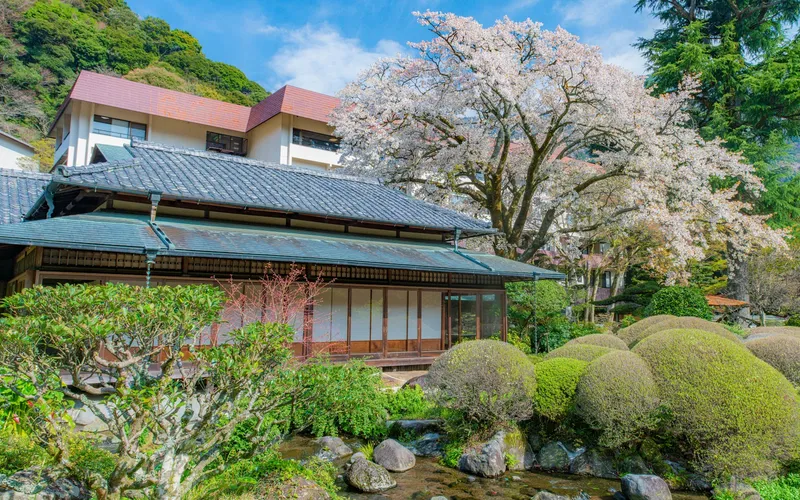
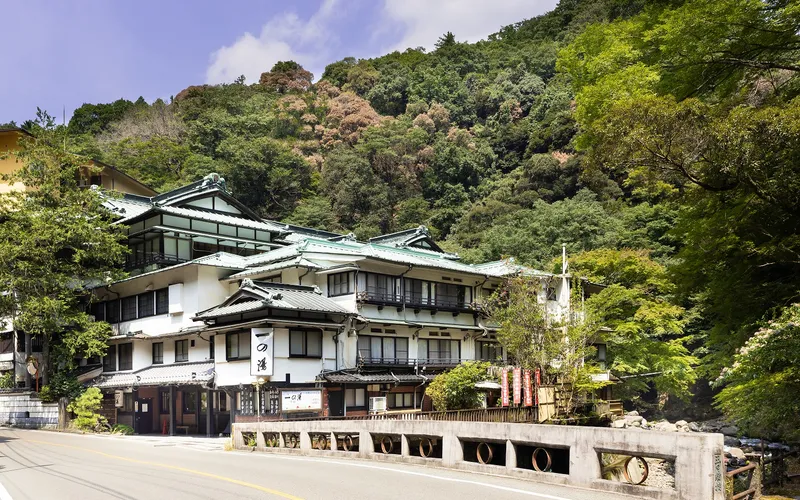
A wooden four-storey sukiya inn founded in 1630 and registered as a Tangible Cultural Property — "登録有形文化財に登録されている、1630年創業の老舗宿". The building is the attraction.
The cheapest lodging in this harvest by a wide margin, and it sells day bathing too: the tourist board lists ¥1,400 for adults and ¥700 for children aged 4 to 12, 13:00–20:00.
Only riverside room classes have a private tub — "渓流沿いの露天風呂付き客室". Standard rooms use the shared baths.
No tattoo policy published on the property site or its tourist-board listing. The private family bath is the way around it; the inn's own /spa/ page returned a 404 when we checked.
Booking links may earn this site a commission at no cost to you; it never changes what we report. Rates shown are the November 2026 per-room snapshot described above, not the half-board rate most of these inns actually sell.
Prefer to browse everything bookable in Hakone? Search all stays:
Where the Water Actually Is
Hakone is not one spring but a mountain of them, and the tourist board publishes source counts, temperatures and flow rates district by district. Where you sleep decides what comes out of the tap: the bottom of the valley has the volume, the middle has the heat, and the top has the sulfur.
Hakone-Yumoto and Tonosawa
gateway, lowest and busiest, where the Romancecar stops
74 sources, 73–171°F / 23–77°C4,679 litres a minute — the biggest flow in Hakone by farThe big day-use houses: Tenzan Tohji-kyo and Hakone Yuryo
Sengokuhara is absent from the official four-district breakdown, so nobody publishes its water chemistry. Space and silence are the trade for loop convenience.
⟷Ashinoyu, up on the pass above Lake Ashi, is the only Hakone district with genuinely sulfurous water — 4 sources, 79–183°F / 26–84°C, 319 litres a minute — but it has no rail access and no property in this set.
⟷From Tokinoyu Setsugetsuka or Tensui Saryo you are a minute from Gora station, which means the cable car, the ropeway and Owakudani are a morning, not an expedition.
⟷Staying at Yoshiike or Tonosawa Ichinoyu Honkan puts you within a few minutes of Tenzan and Hakone Yuryo — the two places in Hakone where a tattooed visitor can walk into a communal bath, covered in day use.
hot springs on-sitewalk to the springsdrive to the springsno thermal water
Hakone Onsen by the Numbers
The load-bearing figures, each kept with the source that published it — and the two that contradict each other.
Legal threshold for "onsen"
77°F / 25°C
Under the Hot Springs Act, water qualifies if it emerges at 77°F / 25°C or hotter, or contains at least one of 19 listed minerals above a set concentration. A sento is boiler-heated tap water and makes no such claim.
Hakone-Yumoto flow
4,679 litres/min
Across 74 sources at 73–171°F / 23–77°C, per the Hakone tourist board's district breakdown — the largest flow in Hakone by a wide margin.
Hottest district sources
104–205°F / 40–96°C
Kowakudani's 22 sources, per the same breakdown. Gora runs 86–199°F / 30–93°C, Ashinoyu 79–183°F / 26–84°C.
Yoshiike's own supply
720 litres/min
Six proprietary sources at 109–176°F / 43–80°C, sodium-calcium chloride, pH 8.40, per the ryokan's own onsen page. A secondary Japanese source gives a single 134.6°F instead of the range.
Tenzan day-use flow
347 litres/min
"計7本の源泉から毎分347㍑" — seven sources overflowing the tubs all day, source temperature 149.7°F, per tenzan.jp. Entry ¥1,450 adult, ¥700 child, cash only.
Hakone Freepass
¥7,100
Two days from Shinjuku (¥7,500 for three), covering unlimited rides on eight modes of transport. The Romancecar limited-express surcharge is ¥1,200 adult on top.
The Four Words That Decide What You Book
Onsen is a legal category in Japan, defined by the Hot Springs Act and administered by the Ministry of the Environment. Water qualifies if it comes out of the ground at 77°F / 25°C or hotter, or if it carries at least one of 19 listed mineral substances — lithium, strontium, iron, sulfur compounds, silicic acid, radon and others — above a specified concentration. That second clause is why a spring cooler than 77°F / 25°C can still legally be an onsen, and why a source right at the threshold is legally onsen but has to be reheated before anyone can sit in it. A sento, by contrast, is a public bathhouse running ordinary tap water through a boiler: same etiquette, same layout, no mineral claim. In Hakone the distinction is mostly academic — the district is built on 17 registered hot springs — but it is worth carrying to every other town in Japan.
The word Japanese guests actually scan for is kakenagashi, or more precisely gensen kakenagashi (源泉かけ流し): source water that flows into the tub and overflows away, never filtered and never reused. Japan-guide calls it "the top quality onsen water". The opposite is junkan-shiki (循環式) — filtered, chlorinated and pumped round again, which is what a property does when its flow cannot fill its tubs. The same source is blunt about the result: "Many facilities, especially those that lack an abundant flow of fresh hot spring water, filter and recirculate the water in their baths. Needless to say, these are not considered top-quality baths."
The practical reading rule is that a property with kakenagashi says so in Japanese on its own homepage, and silence usually means circulation. On this page that claim is verifiable on exactly three: Hakone Suishoen with "全室源泉かけ流し露天風呂のお部屋", Madoka no Mori with "源泉掛け流し" in every room, and Yoshiike Ryokan with "源泉掛け流し100%本物の天然温泉" from six of its own wells. No English listing for any of the three carries that sentence.
Two more words sort the rooms. Rotenburo (露天風呂) is the open-air bath, usually stone or hinoki cypress; uchiyu (内湯) is the inn's indoor one. Both are normally communal and gender-separated. Kashikiri-buro (貸切風呂), also called kazoku-buro, is a bath you reserve for your own group for 45 to 60 minutes — and it is the single most useful facility in Japan for a Western visitor, and it is what makes a tattooed visit workable almost anywhere in Hakone.
Tattoos in Hakone: Two Yeses, Three Maybes, Nine Silences
This is the fact that decides where a tattooed visitor can actually bathe, and the answer is better than the internet's reputation suggests — but it is property by property, and it comes in three tiers. Start with the good news. Hakone Yuryo, the modern day-use house at Tonosawa, removed the restriction outright: "2025年4月1日よりタトゥーによる入浴制限を解除させていただいております" — from 1 April 2025 the tattoo bathing restriction is lifted. No seals, no group limit, no conversation at the desk. Tenzan Tohji-kyo, the riverside bathhouse up the Sukumo valley, goes almost as far but not quite: "現在はおひとりであれば刺青があろうとお断りはしておりません。したがって複数名でのご利用は固くお断りします" — one tattooed person is fine, a party of several tattooed people is firmly refused.
The second tier covers tattoos with seals. Yoshiike Ryokan has allowed it since 1 December 2023: two cover seals of 10×14 cm, sold at the front desk for ¥250 each, after which the large bath and the open-air bath are open to you. Tensui Saryo inherits the same approach from its operator, Relo Hotels & Resorts, which applies it across the group — two seals of 10×15 cm at ¥250 each, covering baths, pool, sauna and rotenburo, with refusal to use them grounds for denial. Yunessun splits the difference by zone: in the swimsuit water park "you may use the facilities provided that you cover your tattoos with a rash guard or similar attire", while in the nude-bathing Mori no Yu "you may use the facilities only if your tattoos can be completely covered by two of our designated tattoo cover seals" — all against a house baseline that guests with tattoos, "including small, one-point tattoos, are generally not permitted entry".
The third tier is the largest and the one nobody writes about. Gora Kadan, Ryokan Hakone Ginyu, Hakone Suishoen, Madoka no Mori, Hakone Gora Karaku, Tokinoyu Setsugetsuka, Laforet Gora Yunosumika, Hakone Retreat, Onsen Ryokan Chisuji and Tonosawa Ichinoyu Honkan publish nothing at all. Not a ban, not a permission — nothing. The correct record for all of them is "not published, ask before booking", and if this page is useful for one thing, it is refusing to convert that silence into a yes. Aggregator sites do exactly that, which is why their Hakone tattoo lists are worth nothing until you check each property yourself.
The workaround is structural rather than diplomatic, and Hakone's own tourist board recommends it: book a room with its own private open-air bath, or reserve a kashikiri-buro. It notes that over 100 Hakone properties have hot springs and many rent private baths, quoting roughly ¥2,000 extra at Hakone Kowakien Ten-yu. It is also candid about why the bans exist: "being tatooed in Japan has been historically frowned upon because of the association with organized crime (although this is slowly changing)", with the practical advice to avoid full-body tattoos and large groups of heavily tattooed people in communal baths.
Uncovered, no conditions — Hakone Yuryo, day use, since 1 April 2025
Uncovered, one person at a time — Tenzan Tohji-kyo, day use, groups refused
Two seals, 10×14 cm, ¥250 each — Yoshiike Ryokan, since 1 December 2023
Two seals, 10×15 cm, ¥250 each — Tensui Saryo, via the Relo Hotels group policy
Rash guard in the swimsuit zone, two seals in Mori no Yu — Yunessun, baseline "generally not permitted"
Not published, ask before booking — Gora Kadan, Ginyu, Suishoen, Madoka no Mori, Gora Karaku, Setsugetsuka, Laforet Gora Yunosumika, Hakone Retreat, Chisuji, Tonosawa Ichinoyu Honkan
Bathing Without a Room
You do not have to book a ryokan to get into Hakone's water, and if you are staying in a cheap hotel down in Yumoto, day use is the whole trip. Tenzan Tohji-kyo is the serious one: a rambling toji complex in Oku-Yumoto with stone rotenburo terraced down toward the river, tatami rest rooms, nude bathing and gender separation. Seven sources at 149.7°F push 347 litres a minute through the tubs all day, which is free-flowing volume rather than recirculation. Entry is ¥1,450 for adults and ¥700 for children from age 1 through elementary school, 9:00 to 23:00 with last entry at 22:00, cash only. Guides widely repeat a ¥1,350 rate with the Hakone Freepass; the official page mentions no discount, so do not count on it.
Hakone Yuryo, one stop away at Tonosawa with its own free shuttle, is the modern alternative and the one with no tattoo restriction at all. The communal bath runs ¥1,700–1,800 on weekdays and ¥2,000–2,200 at weekends and holidays, ¥1,000 for elementary-school children, 10:00 to 20:00 on weekdays and to 21:00 at weekends. It also rents 19 private open-air rooms by the 120-minute slot, from ¥10,400 on a weekday for two people. One hard rule: children below elementary-school age cannot use the communal bath building at all — "小学生未満のお子様は、大浴場棟をご利用いただけません" — so families with toddlers must take a private room.
Yunessun in Kowakudani is a hot-spring theme park rather than an onsen: swimsuits on, children everywhere, and the novelty wine, coffee, green tea and sake baths the internet knows it for. Its nude-bathing half, Mori no Yu, is a separate ticket with separate hours and separate rules — buy the wrong one and you arrive naked at a waterslide or fully dressed at a silent forest bath. The official price page gives ¥2,500 for adults and ¥1,400 for children at Yunessun, ¥1,500 and ¥1,000 at Mori no Yu, and ¥3,500 and ¥1,800 for the combined passport, all on standard A-dates. Japanese secondary sources report ¥2,900 and ¥1,900 for the same two zones, which is consistent with a peak date rather than an error — both figures are in print, and weekends cost more than weekdays either way.
Two of the inns on this page sell day bathing too. Yoshiike Ryokan is listed by the tourist board at ¥2,250 for adults and ¥1,650 for children, 13:00 to 20:00, which buys a garden rotenburo fed by six of its own springs — though the ryokan's own day-trip page did not carry the figure when we checked, so confirm on the day. Tonosawa Ichinoyu Honkan is the cheap historic option at a listed ¥1,400 for adults and ¥700 for children aged 4 to 12, same hours, in a wooden inn that has been standing since 1630.
Tonosawa Ichinoyu Honkan — ¥1,400 adult, ¥700 child (4–12), 13:00–20:00, per the tourist board
Mori no Yu — ¥1,500 adult, ¥1,000 child on A-dates, 11:00–20:00, seals required
Hakone Yuryo — ¥1,700–2,200 adult by day of week, 10:00–20:00 or 21:00, no tattoo restriction
Yoshiike Ryokan — ¥2,250 adult, ¥1,650 child, 13:00–20:00, per the tourist board
Yunessun swimsuit zone — ¥2,500 adult, ¥1,400 child on A-dates (¥2,900 and ¥1,900 reported elsewhere)
Yunessun + Mori no Yu passport — ¥3,500 adult, ¥1,800 child
Hakone Yuryo private open-air room — from ¥10,400 for two people, 120 minutes
Why the Prices Look Wrong
Every rate in the table above is per room and room-only, harvested from booking sites for the same three November nights. Almost none of these properties actually sell that. A Japanese ryokan quotes per person, per night, with an elaborate kaiseki dinner and breakfast included — 1泊2食付 — and japan-guide puts the national average at ¥15,000 to ¥30,000 per person per night on that basis. Two people in one room therefore pay roughly twice the headline, and get two multi-course dinners for it. Compare a ryokan's own quote against an OTA room-only figure and you will conclude the inn is gouging you, when in fact you are pricing two different products.
Hakone Retreat is the one property in this set confirmed to quote per villa rather than per person, which makes it the only rate on the page that means what a hotel rate normally means. It is also the best argument here for checking more than one channel: for the same November stay, Agoda showed $456 while Expedia and Hotels.com both showed $879 — a $423 spread on a single property, same dates, same villa category.
The direction of the discount is not fixed either. At Tensui Saryo the operator's own booking site came in below every OTA in this harvest, and the Ichinoyu group states plainly that its own website beats the booking sites. Madoka no Mori includes dinner and breakfast and posts rates with service charge and consumption tax already in them, so its number is bigger and covers more. Ryokan Hakone Ginyu and Gora Kadan publish no rate at all and take bookings by phone or email — that is a convention of the class, not a signal of unavailability.
The practical sequence: decide the meal plan first, then get the property's own quote for it, then check two OTAs against that quote, and only then compare properties. Doing it in the other order produces the confusion this section exists to prevent.
Getting There, and What We Could Not Check
Hakone is the onsen you can reach from Tokyo before lunch. The Odakyu Romancecar runs Shinjuku to Hakone-Yumoto in about 80 minutes, with a ¥1,200 adult limited-express surcharge on top of your ticket or pass. Buy the Hakone Freepass — ¥7,100 for two days, ¥7,500 for three from Shinjuku — and you get unlimited rides on eight modes of transport, which is not a gimmick: the classic loop runs mountain railway to Gora, cable car to Sounzan, ropeway over the Owakudani steam vents, pirate ship across Lake Ashi and bus back down. You do not need a car and should not rent one. The loop is the sightseeing, ryokan parking is finite, and the pass costs less than two days of rental before you have paid for petrol.
One caveat about the top of the loop. Owakudani is an active volcanic vent, gas concentration is monitored continuously at the ropeway stations, and the area closes at short notice — it was shut from 19 May to 16 November 2024 when the alert level rose. Travellers with asthma, respiratory or heart conditions, and pregnant travellers are officially advised to stay out of the steam-vent area. Check the status the morning you plan to ride rather than the week before.
Now the gaps in this page, stated plainly. The Hakone Ropeway's official site failed DNS resolution during this research, so the Owakudani monitoring and closure details come from the Hakone tourism site and secondary reporting, not from the operator. Four Yunessun URLs returned 404s, including both English price paths; the working price page is the Japanese one, and the English tattoo wording was read off the site root. Tonosawa Ichinoyu Honkan's own /spa/ page 404'd, so its day-use price is the tourist board's figure rather than the inn's. Yoshiike's source temperature is published two ways — a range of 109–176°F / 43–80°C across six wells on its own onsen page, and a single 134.6°F in a secondary Japanese source — and we have kept the range.
Three further limits worth knowing. Sengokuhara has no source count, temperature range or flow rate in the official four-district breakdown, so nothing is claimed here about Hakone Retreat's water chemistry. Gora's partly "created" supply is stated for the district, not for any named inn, and we have not attributed it to one. And whether a property quotes per person or per room was confirmed directly only for Madoka no Mori and Hakone Retreat; for the rest it is the Japanese ryokan convention, described as a convention rather than a verified per-property fact.
Hakone Onsen Ryokan: Questions
Can you use an onsen in Hakone if you have tattoos?
Yes, in specific places. Hakone Yuryo lifted its restriction entirely on 1 April 2025, and Tenzan Tohji-kyo admits one tattooed bather at a time while refusing groups. Yoshiike Ryokan and Tensui Saryo allow tattoos covered by two ¥250 seals. Ten other properties we checked publish no policy at all, which is not permission — see tattoos in three tiers.
What does kakenagashi mean, and does it matter?
Gensen kakenagashi means the source water flows into the tub and overflows away without being filtered or reused. Japanese guests treat it as the quality marker, and japan-guide says recirculated baths are "not considered top-quality baths". Properties with it advertise it in Japanese on their own sites; here that is Hakone Suishoen, Madoka no Mori and Yoshiike Ryokan.
Do I need a room with a private open-air bath?
You need one if you have tattoos, if you are uncomfortable bathing naked among strangers, or if you want to soak at three in the morning. Five properties here put one in every room, so there is no upgrade to negotiate: Ginyu, Suishoen, Madoka no Mori, Gora Karaku and Setsugetsuka. Otherwise a reservable kashikiri bath for 45 to 60 minutes does the same job for around ¥2,000.
Why are Hakone ryokan prices quoted per person?
Because a ryokan sells a night with dinner and breakfast, not a bed. The convention is 1泊2食付 — kaiseki dinner and breakfast included, ¥15,000–30,000 per person per night nationally — while the rates in our table are per-room, room-only booking-site figures. Hakone Retreat is the exception that quotes per villa. Details in why the prices look wrong.
Do I need a car in Hakone?
No, and a car is a liability here. The Hakone Freepass covers eight modes of transport for ¥7,100 over two days from Shinjuku, and the loop — mountain railway, cable car, ropeway, lake cruise, bus — is itself the sightseeing. The Romancecar takes about 80 minutes from Shinjuku with a ¥1,200 limited-express surcharge. Only Sengokuhara properties need a bus rather than a train.
Which day bath should I choose if I am staying somewhere without an onsen?
Tenzan Tohji-kyo for the real thing — seven sources, 347 litres a minute, ¥1,450, cash only, but nude and gender-separated. Hakone Yuryo for the same experience without any tattoo restriction, from ¥1,700. Yunessun if you have children or want to keep a swimsuit on, ¥2,500 on standard dates. All three are covered in bathing without a room.
Hakone or Kinosaki for a first onsen trip?
Hakone if you are based in Tokyo and want the bath inside your room — it is 80 minutes from Shinjuku, and five of the inns here give every room a private open-air onsen. Kinosaki suits a Kansai trip and works the opposite way: the town's seven public bathhouses are the attraction, your ryokan hands you a pass to them, and you walk between them in a yukata.